Data Distortions
Introduction
Law can generate data in two principal ways.[1] First, creating law generates data. Legislatures hold hearings, write reports, and pass laws. Agencies issue notices, take comments, and promulgate rules. Parties file pleadings, and courts hear cases, create transcripts, and publish decisions.[2] Second, law can require the production of data. For example, securities laws require companies to generate, file, and disclose information.[3] Property law requires valid transfers to be publicly recorded. And drug law requires firms to generate information about the safety and efficacy of their products prior to marketing.
Although the law’s information production function is broadly recognized across a wide range of topics,[4] less attention is directed to when or how it functions to produce information. Professor Janet Freilich has argued that the law’s inattention to its own data-generating practices can have unintended effects.[5]
This Essay argues that there is another understudied aspect of law’s data production function that can have significant unintended, distortionary effects: data presentation.[6] In other words, how data are presented can be just as important as whether data are produced. This argument builds on scholarship showing that laws mandating data disclosure may not achieve their intended goals—such as meaningfully improving consumer choice by reducing information asymmetries—through information production alone.[7]
While much of this literature analyzes mandated consumer disclosures,[8] this Essay concerns a different informational universe: laws that require regulated entities to generate, collect, analyze, and present data to regulators or expert audiences.[9] And it concerns a different problem: Regulated entities have economic incentives to distort data to reduce the regulators’ (and experts’) ability to detect signals that could lead to penalties. Like other shortcomings associated with information-production laws, data distortions undermine the goals of data production.
Consider a few examples. Certain firms must file financial reports with the Securities and Exchange Commission, which are published and freely available online. Markets may incorporate and react to negative information in annual reports, leading to a decline in stock prices. Firms, therefore, have incentives to reduce the market’s incorporation of negative information by making it costly to extract. One example is firms burying negative information in footnotes rather than including it in the body text of the report.[10]
Or take federal workplace safety law. Employers with more than 10 employees must maintain records of serious work-related injuries and illnesses and report any severe injury or fatality directly to the Occupational Safety and Health Administration.[11] To increase costs for regulators identifying safety signals, firms may describe recorded injuries in ways that minimize their severity.[12]
In both of these cases, law expressly requires the production of information, but those that produce it can distort what they report. The result: Data presentation can undermine the goals of data production.
This Essay explains these distortions in data presentation—what it calls data distortions—using the example of medical device adverse event reporting. Federal law consciously requires the production of adverse event reports to serve as an “early warning system”[13] for device-related safety issues.[14] Yet, just like with employers reporting workplace injuries, device manufacturers reporting adverse events may use different terms to minimize the nature of injuries,[15] increasing the costs of regulators looking for safety signals.[16] In both cases, incentives to distort data are economic: manufacturers reduce expected penalties by making it more costly for regulators to detect safety concerns in reported data. And while these distortions may be intentional, they are not necessarily so. In other words, some firms may distort data to avoid regulatory detection, while others may lack incentives to correct distortions that arise innocuously.
However they arise, data distortions can undermine the purpose of producing the information in the first place. In the case of medical devices, distortions make safety signals difficult to detect, delaying or reducing the probability of regulator actions that can protect patients. If regulators cannot detect safety problems at all or in a timely manner, the data collected will be less likely to serve their legal purpose: to act as an early warning system for unsafe devices.
Detecting postmarket safety issues for medical devices is particularly important because the premarket authorization process cannot reliably identify them.[17] Unlike most drugs, which are usually tested in thousands of patients prior to marketing authorization, most devices reach the market either with weak[18] or no human clinical testing.[19] This means many device risks are not identified and understood until injury occurs—which likely happens far more than 450,000 times per year.[20] As a result, postmarket safety data are critical to understanding whether and what safety risks devices pose to patients.
When data are distorted, the system cannot reliably, accurately, or efficiently identify device safety issues.[21] Not only does this encourage waste and potential patient harm, it also can undermine innovation by encouraging iteration on unsafe devices.
To reduce data distortions, minimize patient harm, and generate quality innovation, this Essay analyzes how law, regulation, litigation, and markets can increase expected penalties for manufacturers. While none of these methods are likely to significantly reduce distortions, this Essay suggests that some combination of them would make a meaningful difference.
The Essay is structured as follows. Part I explains how the federal government regulates medical devices, mandates reporting adverse events, and enforces its reporting regulations. Part II shows that manufacturers have two economic incentives to distort reported information to reduce expected penalties—one to affirmatively distort and another to be indifferent toward distortions that arise innocuously. It then explains why distortions matter. Part III explores several mechanisms to reduce distortions: legislation, regulation, litigation, and the market.
The Conclusion summarizes the Essay and identifies directions for future research.
I. Medical Devices & Reporting
Medical devices are regulated before and after marketing authorization. This Part briefly introduces device regulation, focusing on postmarket data reporting requirements. Section A describes medical device regulation, the purpose of postmarket data collection, and the databases of postmarket adverse event information. Section B then explains the postmarket reporting requirements for medical device manufacturers. Section C describes how public and private regulators can sue based on reporting violations.
A. Devices & Reporting Database
Medical devices have not always been regulated by the FDA or tracked in government databases. This section briefly explains what devices are, how they are regulated, and the relevant databases of medical device adverse events.
When Congress granted the FDA authority to regulate devices in 1976, it defined “device” broadly to include a variety of products “intended for use in the diagnosis of disease or other conditions, or in the cure, mitigation, treatment, or prevention of disease . . . .”[22] The legislation also categorized devices into three classes of risk, conditioning market access on levels of regulatory review that correspond to the risks posed by the device. Class I devices are low risk and typically do not require regulatory review.[23] Class II devices are moderate risk and typically are “cleared” through the Premarket Notification process (also known as the 510(k) pathway).[24] While a manufacturer must demonstrate that it is “substantially equivalent” to an existing legally marketed device (predicate),[25] proof typically does not require clinical trial data.[26] Class III devices are the highest risk, and most require clinical trial data to support an application for Premarket Approval (PMA).[27] Later, Congress created a new pathway—de novo review—for some low-to-moderate risk devices that cannot demonstrate substantial equivalence to a predicate, which typically requires some clinical evidence.[28]
Creating a system of premarket review was an important but incomplete way to regulate. In part because not all risks can be identified premarket, and in part because the premarket device review process is relatively porous, the FDA needs postmarket information to “determin[e] whether a device complies with” federal law or poses a risk to “public health.”[29] To capture this information, Congress empowered the FDA to generate and collect the data by requiring those making, importing, or distributing the devices to report them.[30] These data collection and reporting requirements have changed over time, expanding to ensure more complete, robust, and accurate information.[31]
Today, the primary public database related to adverse events associated with medical devices[32] is the Manufacturer and User Facility Device Experience database (MAUDE).[33] Data for MAUDE are collected through MedWatch,[34] a system that encompasses both the mandatory reporting program and voluntary reporting programs. MedWatch also publishes safety alerts based on data it receives.[35] Additionally, the FDA collects data through the Medical Product Safety Network (MedSun), which is composed of a select group of facilities that treat patients using medical devices.[36] Although MedSun reports are now included in MAUDE, until 2012 they were excluded.[37]
B. Device Reporting Requirements
Although each adverse event database remains an important source of information, they are all limited in scope. Not all adverse events related to medical devices are legally required to be reported, and not all persons who report adverse events are legally required to do so. This section explains the Medical Device Reporting Regulation (MDR Regulation),[38] which is the federal regulation governing mandatory reporting of adverse events associated with medical devices (Medical Device Reports or MDRs). It describes to whom the reporting requirements apply and what type of information triggers reporter obligations.
For devices, federal regulations divide mandatory adverse event reporting requirements into three broad categories: (1) manufacturers and importers,[39] (2) “device user facilities,”[40] and (3) other actors in the healthcare system, such as physicians and consumers.
Legal obligations to report differ by category. Physicians, consumers, and patients do not have to report suspected adverse events to the FDA, the manufacturer, or anyone else—but they may do so voluntarily.[41]
Manufacturers and importers, by contrast, are obligated to report certain adverse events that involve malfunctions, serious injuries, and deaths directly to the FDA within certain timeframes.[42] For manufacturers, MDRs are required only if the manufacturer “receives or otherwise becomes aware” of information that “reasonably suggests” its device, or a malfunction of it, caused or contributed to death or serious injury.[43] They also have duties to investigate, obtain, and submit (missing) information about the reported
event.[44] For malfunctions of certain eligible Class I and II devices that are not permanently implantable, life supporting, or life-sustaining, manufacturers may be able to submit summary reports on a quarterly basis.[45]
A device user facility—a “hospital, ambulatory surgical facility, nursing home, or outpatient treatment facility which is not a physician’s office”[46]—has similar reporting triggers but most often must report to manufacturers rather than the FDA (see Figure 1).[47] Importantly, when device user facilities report MDRs to manufacturers, it can trigger manufacturers’ reporting obligations. All mandatory reporters—manufacturers, importers, and device user facilities—must include certain information and use the required Form 3500A.[48]
Figure 1: Mandatory Reporting Device Adverse Event Obligations
| Reporting Entity |
Information Acquired |
Type of Information | Mandatory | Reported To (method) |
Within |
| Manufacturers & Importers[49] | “receives or otherwise becomes aware”[50] | “reasonably suggests that one of its marketed devices . . . may have caused or contributed to a death or serious injury”[51]
OR “has malfunctioned and that such device or a similar device marketed by the manufacturer or importer would be likely to cause or contribute to a death or serious injury if the malfunction were to recur.”[52] |
Yes | FDA
(MAUDE) |
30 days |
| Device User Facility[53] | “receives or otherwise becomes aware”[54] | “reasonably suggests that a device has or may have caused or contributed to the death of a patient of the facility.”[55] | Yes | FDA (MAUDE); if the manufacturer is known, to the manufacturer[56] | 10 days, although the Secretary can prescribe a shorter duration in the case of deaths.[57] |
| Device User Facility[58] | “receives or otherwise becomes aware”[59] | “. . . reasonably suggests that a device has or may have caused or contributed to the serious illness of, or serious injury to, a patient of the facility”
OR (ii) “other significant adverse device experiences”[60] |
Yes | Manufacturer (none), unless unknown, then FDA (MAUDE).[61] | 10 days[62] |
| Health Care Professional[63] | None | None | No | FDA (MAUDE) |
n/a |
| Other | None | None | No | FDA (MAUDE) |
n/a |
Given how the MDR Regulation defines these terms, it imposes broad obligations.[64] For example, a manufacturer’s duty to report an adverse event only requires knowledge that the device may have caused or been a factor in the adverse event.[65] Likewise, reporting obligations apply to “serious injur[ies],” which includes those that are “life-threatening,” result in permanent impairments, or require “medical or surgical intervention” to prevent permanent impairments.[66] And “malfunction” does not mean only failure to meet “performance specifications” but also a much broader definition: “to otherwise perform as intended.”[67]
The FDA has also broadly defined other terms. For example, a manufacturer must receive (for example, from a device user facility) or “become aware”[68] of the reportable information to trigger reporting obligations. Awareness, in turn, is defined to mean awareness by supervisors of a wide range of activities.[69] And because reportable information includes “any information”[70] “from any source,”[71] manufacturers must report events derived from more than simply direct reports, including “trend analysis,”[72] scientific studies, and case reports in the literature. Additionally, a manufacturer must submit any information “reasonably known” to it, including information it can obtain by contacting reporters or testing the device.[73] These requirements apply even to foreign manufacturers if their “devices are distributed in the United States.”[74]
Additionally, reporting is not required unless the information “reasonably suggests that one of their marketed devices . . . may have caused or contributed to a death or serious injury” or “is likely to cause or contribute to a death or serious injury” should a malfunction recur.[75] Yet relevant information that can reasonably suggest a reportable event includes “professional, scientific, or medical facts, observations, or opinions,”[76] such as those that appear at conferences or in the medical literature. For events identified in the literature, the FDA instructs manufacturers to report each event type (but not each individual event) identified in the literature as separate reports and to attach or link to the document.[77]
Despite the capaciousness of these definitions, they are not all-encompassing. Terms like “reasonably suggests” and “awareness” are still open to interpretation. In other words, manufacturers still have discretion to decide whether something is reportable. Three obvious examples of this discretion are baked directly into the MDR Regulation—specifying when manufacturers have no obligation to report. First, manufacturers are not required to report an adverse event if they “have information that would lead a person who is qualified to make a medical judgment reasonably to conclude that a device did not cause or contribute” to serious injury or death.[78] Second, manufacturers are not required to report device malfunctions if “a malfunction would not be likely to cause or contribute to a death or serious injury if it were to recur.”[79] Third, to avoid duplicate reporting, manufacturers also are not required to report events in the literature that match existing reports,[80] though determining the identity of events is challenging. Each of these exceptions leaves significant discretion for manufacturers.
C. Regulatory Actions for Reporting Violations
Despite the existence of broad reporting obligations, not all entities comply with them. This section explains potential regulator actions when manufacturers violate device reporting requirements. Although public entities like the FDA and the Department of Justice (the DOJ) are the primary public regulators, private parties can also act as regulators by bringing claims under state and federal law.[81] Subsections 1 and 2 explain public and private regulator actions respectively. Subsection 3 outlines the limits of regulatory power.
1. Public Regulators.—Public regulators like the FDA and the DOJ police MDR Regulation violations and enforce the law. Three provisions of the Federal Food, Drug, and Cosmetic Act (FDCA) expressly concern the MDR Regulation. The fourth is a catch-all rarely used in the context of medical device reporting.[82] First, manufacturers can be liable when they “[fail] or [refuse] . . . to furnish any notification or other material or information required by or under” the medical device reporting requirements of the FDCA.[83] Second, a manufacturer is liable when it submits a report “that is false or misleading in any material respect.”[84] Penalties can be criminal or civil.[85]
Consider Guidant LLC,[86] which submitted a required annual report to the FDA that falsely stated it had made a “minor alteration” to its implantable cardioverter defibrillator.[87] In fact, Guidant changed the design of its device after discovering a defect caused the defibrillator to fail, resulting in the death of at least one patient.[88] The manufacturer pled guilty to both refusing to report a device correction and making false statements,[89] paying $296 million in fines and penalties.[90]
Third, a manufacturer that fails or refuses to furnish any material or information required by statute and regulation in device reporting is also liable for misbranding.[91] Misbranding occurs when a device’s “labeling is false or misleading in any particular.”[92] Under statute, a failure to file MDRs renders the device’s labeling false or misleading.[93] For example, Olympus pled guilty to misbranding and agreed to an $85 million fine for failing to file and supplement adverse event reports.[94]
Fourth, a manufacturer can also be criminally liable when it “(1) falsifies, conceals, or covers up by any trick, scheme, or device a material fact; (2) makes any materially false, fictitious, or fraudulent statement or representation; or (3) makes or uses any false writing or document knowing the same to contain any materially false, fictitious, or fraudulent statement or entry.”[95] In 2003, for example, Endovascular Technologies, Inc. pled guilty under this provision for misleading an FDA inspector and failing to disclose hundreds of adverse event reports.[96]
Each of these four provisions provides a potential means of policing violations of the MDR Regulation—as long as regulators have information about the violations. Regulators have several methods for obtaining information about potential violations. One is FDA inspections of manufacturers to ensure compliance with the MDR Regulation,[97] which can reveal defects in reporting requirements or uncover unreported events.[98] Second, public regulators may learn of violations during an investigation into adverse events reported to the FDA (or discrepancies therein). Third, private litigants can sue, which may generate new information about whether and how the manufacturer withheld or distorted data.[99] Fourth, news reporting may generate information that regulators can use as the basis for an investigation.[100]
2. Private Regulators.—Even when public regulators do not pursue cases for violations of MDR Regulations, private regulators can. This section shows that most successful private litigation is based on failure to report data, rather than acting to distort it—and even these actions face significant challenges.
Consider four areas where MDR-Regulation-based claims can arise: tort, securities, federal reimbursement, and other state laws, such as unfair and deceptive practices statutes. In tort, injured patients have argued that devices are defectively marketed because manufacturers failed to report adverse events to the FDA.[101] Defective marketing claims allege that a manufacturer did not discharge its duty to warn physicians of material risks associated with the product.[102] Patients have alleged that a manufacturer breached this duty by failing to report adverse events to the FDA. Because the physician would not have used the device if the manufacturer had reported the adverse events, the patient can argue the failure to report caused her injury. Some courts allow these claims,[103] while others block them for doctrinal (e.g., lack of proof, causation)[104] or constitutional reasons (e.g., preemption).[105]
In addition to tort law, plaintiffs may sue manufacturers for potential reporting violations under federal securities law.[106] Claims typically center on a manufacturer providing false or misleading information about its devices, which sometimes includes MDRs.[107] For example, in one case, a plaintiff alleged that Intuitive Surgical made materially false or misleading statements about the safety and effectiveness of its surgical robot by underreporting and misclassifying serious adverse events.[108] Although this case survived a motion to dismiss,[109] it seems to be an outlier.[110] Most of the other cases involving securities fraud involve failure to report information to investors or the public, rather than failure to report it to the FDA.[111] And even these are not especially common.
Besides tort and securities claims, individuals may also sue manufacturers (on the government’s behalf) under the False Claims Act (the FCA),[112] which prohibits fraud on the government. However, the FCA is not well-adapted for policing data distortions for several reasons. First, the plaintiff must plead specific instances of fraud.[113] Second, the plaintiff must show the fraud is material to the government’s decision to pay.[114] Data distortions are both not always obvious—and it is unclear how they may relate to payment decisions. Perhaps this is why most cases in the device context are focused on promotional activities that mischaracterize or hide evidence[115] rather than adverse event reporting.[116] It also explains why MDR violations, even when included in claims, typically do not form the core of the violation.[117]
3. Limits of Regulator Actions.—Even if regulators want police data distortions, they are limited in important ways. Sometimes the nature of the claim limits their reach. Private regulators, for example, must bring claims for something other than an MDR Regulation violation—financial or physical injury. In tort, for example, the key question is not simply whether the manufacturer violated its reporting obligations, but rather whether doing so caused an injury to a patient (failure to warn).[118] Likewise, in securities and FCA claims, failure to comply with MDR requirements must produce some financial injury.[119]
Other times, the legal doctrine constrains regulator action. Many cases in tort, securities, and the FCA sound in fraud, which often entails difficult issues of proof (like causation) and a heightened pleading standard. Additionally, these lawsuits are based on underreporting or falsifying reported data, rather than distortions of reported data, making the fit imperfect.
Practical realities can also limit regulator action even when the relevant law is specifically designed to address MDR Regulation reporting violations. Public regulators face constraints on resources, expertise, investigative power, penalties, and available evidence. Consider civil penalties, which are capped and contain carveouts for violators whose infractions are “minor”[120] or are not “significant or knowing departure[s]”[121] from the regulatory requirements.[122] This can complicate enforcement where reporting may not clearly violate the letter of the law or may be difficult to prove. And even highly motivated and legally grounded public regulators are subject to changing political preferences and agency priorities, making consistent enforcement across administrations a challenge.
All of these factors influence the probability that a regulator will bring a case under MDR-Regulation-specific laws. This presents a potential opportunity for regulatory arbitrage by manufacturers—that is the subject of the next Part.
II. Incentives for Distortion
Manufacturers face potential fines and penalties if they fail to report adverse event information. To avoid or reduce expected penalties, manufacturers may report in ways that make it more costly for regulators to identify potential safety signals in reported data—what this Essay calls data distortions.
This Part describes the incentives to distort data and identifies existing distortions in MDRs. Section A explains that manufacturers have two economic incentives to distort data.[123] Section B catalogues the different data distortions in adverse event reports.[124] Section C explains the consequences of data distortions.
A. Incentives to Distort
Data distortions may arise for different reasons, including random error, data corruption, and imprecise reporting instructions.[125] This section focuses on two economic incentives to distort: one to affirmatively distort and another to remain indifferent to distortions—to not correct or reduce distortions. In explaining these incentives, this section makes three assumptions. First, manufacturers are profit maximizing. Second, a profit-maximizing manufacturer will comply with reporting requirements up to the point where the expected marginal benefits (i.e., no penalty via enforcement, delayed enforcement) exceed the expected marginal costs (e.g., investing in technology, providing undistorted information). Third, the expected cost of a penalty is the product of the cost of any successful regulatory action multiplied by the probabilities that a violation will be detected and successfully enforced. Each of these probabilities will be a function of several variables, including the resources and information available to the regulator, the costs of monitoring and auditing, the severity of the violation, the regulator’s ability to prove a violation, and the type of regulatory action taken (e.g., warning letter, letter to healthcare providers, enforcement action).
Given these assumptions, data distortions reduce expected penalties by affecting the probability that safety signals will be detected and successfully enforced. For example, distortions could make it more costly for regulators to detect safety issues associated with a device. By increasing regulator detection and monitoring costs, manufacturers can reduce the probability that regulators detect safety signals and decrease their expected penalty.
1. Affirmative Distortions.—A manufacturer may affirmatively distort data to reduce expected penalties. For example, manufacturers may report adverse events like deaths using different terms, such as “hospice” and “passed away.”[126] This kind of data distortion may reduce the probability that a regulator detects safety signals in the data. If a regulator is less likely to detect a safety problem with a device, the regulator is also less likely to bring a successful enforcement action, reducing the total expected penalty.
Firms may also distort data to reduce the probability that a regulator will bring an enforcement action at all and, if it does, influence which type of action it brings. Both of these probabilities are functions of proof.[127] If a particular type of distortion is difficult to prove, it lowers the expected penalty by reducing the probability that regulators (1) decide to enforce (2) a particular type of violation (3) successfully.[128] Consider the FDCA, which exempts from civil penalties violations by persons who commit “minor violations” if otherwise in “substantial compliance”[129] and violations that are not “significant or knowing departure[s]” or “risk[s] to public health.”[130] To the extent that it is difficult to prove that small distortions are more than “minor violations” or that they present clear and significant risks, manufacturers will have incentives to distort data.
And those incentives will exist even if the marginal benefits of distorting are not significant relative to a manufacturer’s overall revenues.[131] For example, suppose that a particular kind of data distortion has a penalty of $50,000 if successfully enforced. Assume further that the distortions are difficult to prove (i.e., 10% chance of success) and enable the manufacturer to continue marketing the device for an off-label use that generates $30,000. Even though the benefits are small ($30,000), the costs are smaller ($5,000). The manufacturer therefore obtains a net benefit ($25,000) by distorting.
On the other hand, distortions also impose costs on manufacturers, which reduces a manufacturer incentive to distort. If more frequent and greater distortions increase the probability of detection or overcome issues of proof, these distortions also increase the expected penalty.[132] When the expected penalty increases, the incentive to distort decreases.
Penalties increase substantially when a manufacturer distorts data in a way that clearly renders it “false or misleading in any material respect[,]”[133] which can result in criminal or civil penalties.[134] One example may be deliberate attempts to mislead or outright lying, such as consistently and deliberately reporting deaths as bruises or paralysis as headaches. Expected penalties for this behavior may include multimillion-dollar judgments and jail time.[135] More mundane distortions, such as occasionally using device aliases or inconsistent product descriptions, are likely to result in less significant penalties, though this is not always the case.[136]
To illustrate, consider a manufacturer that deliberately and significantly distorts data to hide serious safety defects in its device. Without distortions, the probability of detection and successful enforcement is 90% with a penalty of $50 million (expected penalty $45 million). Assume that distortions are so nakedly deceptive that they increase the expected penalty to $1 billion and include jail time. Even if that reduces the probability of detection and successful enforcement to 50% (expected penalty $500 million), a rational manufacturer will not distort in this way.
2. Indifferent Distortions.—Even if manufacturers do not affirmatively distort data, they may be indifferent to distortions that arise for other reasons.[137] In other words, they may lack economic incentives to reduce distortion. In this picture, data distortions occur because of ambiguities in the MDR Regulation,[138] idiosyncratic reporting,[139] or lack of training.[140] For example, adverse event report instructions do not specify how to report devices that have undergone rebranding or other name changes.[141] Manufacturers may report adverse events under the new device name or other reporting fields for innocuous reasons, making it difficult to link adverse events to the same device.
While reducing these distortions is desirable, it is also costly. A rational manufacturer will invest in and implement a new technology that reduces data distortions only when the expected marginal benefits of doing so exceed the expected marginal costs. A profit-maximizing manufacturer would not invest $100 in compliance technology that would reduce the risk of a $1,000 fine by 9.9% because the marginal cost of $100 is greater than the expected marginal benefit of $99 ($1,000 × .099). But it would invest $90 in technology that reduces the risk of a $1,000 fine by 9.9% because the expected marginal benefit of $99 is greater than the marginal cost of $90 (by $9).
This line of reasoning can be extended to other mechanisms that might improve data quality but impose costs.[142] Inconsistencies or distortions may arise because staff may turn over or lack rigorous training.[143] To reduce these distortions, a manufacturer must incur costs: either pay higher wages to retain quality employees or consistently and rigorously train employees who turn over.
But a rational manufacturer will not hire better employees or train them more rigorously if the cost of doing so exceeds the benefits of the resulting lower expected penalty. Thus, a firm with a low-quality employee who inconsistently reports data and lacks rigorous training may not have incentives to invest in rigorous training for a high-quality employee who reports consistently. For example, if the manufacturer can reduce the probability of the $1 million fine from 3% to 1% (expected penalty $10,000) by investing $60,000 to hire a high-quality employee, it is unlikely to do so. Even though it would improve data reporting and reduce liability exposure, hiring the employee would result in a net loss of $15,000 (the expected benefit of hiring the employee is $20,000, but the cost is $35,000).
B. Data Distortions
If manufacturers are rational, they will respond to economic incentives and distort data affirmatively or through indifference. This section identifies and describes six different data distortions that occur in the reporting databases: (1) manufacturer aliases, (2) incorrect product codes, (3) miscoding or noncoding of adverse events, (4) reporting exemptions, as well as (5) mischaracterizing causality, and (6) flooding the zone.
1. Aliases.—Distortions may arise because manufacturer names differ across reports for the same device. Because manufacturers are large entities with many subsidiaries, they may report events under different names or aliases. Sometimes the reports will state the parent firm’s (manufacturer’s) actual name; other times they will state the name of one of the manufacturer’s subsidiaries or the names of an acquired manufacturer.
These distortions can affect how regulators identify safety signals because a standard MAUDE search will not return results when the manufacturer name is preceded by a different word.[144] For example, while a MAUDE search of the field manufacturer name for “Olympus” will capture some variants of the company name, it will miss hundreds of other reports involving Olympus devices, including some with Olympus in the title. To illustrate, on July 7, 2022, Olympus submitted a report with the manufacturer name “SHIRAKAWA OLYMPUS CORP. LTD. CAMERA HEAD.”[145] While the manufacturer name field includes “Olympus,” a MAUDE search for “Olympus” did not reveal that report. The same is true for adverse events reported under other aliases, like NAGANO OLYMPUS CO., LTD.[146] and AIZU OLYMPUS CO., LTD.[147]
Firms also may report the name of the device user facility, acquired (previous) manufacturer, distributor, or person (e.g., physician that reported the adverse event to them) rather than the name of the current manufacturer.[148] For example, some reports that involve Olympus devices list the manufacturer as BERKELEY MEDEVICES,[149] Gyrus,[150] and PKS Lyons,[151] which are either acquired company names or product names of the devices manufactured by Olympus. Other times a device (“Heartstart”) was misspelled (“Hearstart”), making searching difficult.[152]
The same issue may occur with other fields, such as the Brand Name field. If one searches MAUDE for “Da Vinci” under the Brand Name Field, the query will not return results for “Davinci,” and vice versa.[153] Yet there are hundreds of reports under each name. While the detail is small, a person looking for trends in adverse events for devices with a particular brand name may miss them if they do not repeatedly search for different variations.
2. Product Codes.—In addition to distortions in the manufacturer name field, distortions may also occur when manufacturers assign product codes in ways that are inaccurate or misleading to observers. When reporting, manufacturers must select a “product code”[154] that groups their device into classifications set by the FDA[155] and funnel into different reviewer divisions at the FDA.[156] Additionally, observers searching MAUDE might look for trends based on product codes, assuming that the same device would occupy the same product code across reports.
But this can be a faulty assumption. Firms may report events for the same device with different product codes. For example, a search of “Heartstart”—a branded automated external defibrillator—returned over 20 different product codes.[157] Sometimes reports were coded into categories because a component part, such as a wire, failed.[158] Other times, the assigned product code funneled the report into a different specialty from the one relevant to the device—such as an adverse event involving a mesh being assigned a product code for radiology—simply because the event took place during a procedure involving that specialty.[159] And at least 10 reports concerning Heartstart were reported using code IKD, which has a medical specialty and review panel of “physical medicine” even though all reports were about a cable malfunction.[160]
Variations of the same issue arose in the context of transvaginal mesh adverse event reports. In some cases, the product code was for general surgery, which sent the report to the reviewers in the hernia mesh division rather than the gynecological division.[161] Another example is a set of reports for the SynchroMed pain pump when the problem was (also) with a different device: an implantable mesh.[162] Although the difference in codes may seem small, it channeled adverse event reports to different divisions, effectively dividing them between different reviewers.
3. Miscoding, Misclassifying, Reclassifying, or Noncoding Adverse Events.—Manufacturers also code adverse events according to the type of injury caused or device malfunction. Miscoding, misclassifying, reclassifying, or noncoding adverse events can cause distortions. Miscoding occurs when the adverse event is reported as one problem, but the narrative summary reveals the problem is different. One example is a group of three new breast implants that the FDA approved on September 26, 2024. The labeling of the device explains that rupture may occur, sometimes without the patient noticing.[163] Ruptured implants can cause pain, hardening of the breast, and other issues, sometimes requiring reoperation.[164] In some cases, they may cause inflammatory conditions[165] and silicone migration to other parts of the body.[166]
The manufacturer has so far reported four ruptures. However, it has reported 611 incidents, including “breaks” and “rejections.”[167] It has also reported rupture as “fracture” and “crack.”[168] But the term “rupture” appears in the descriptive text.[169]
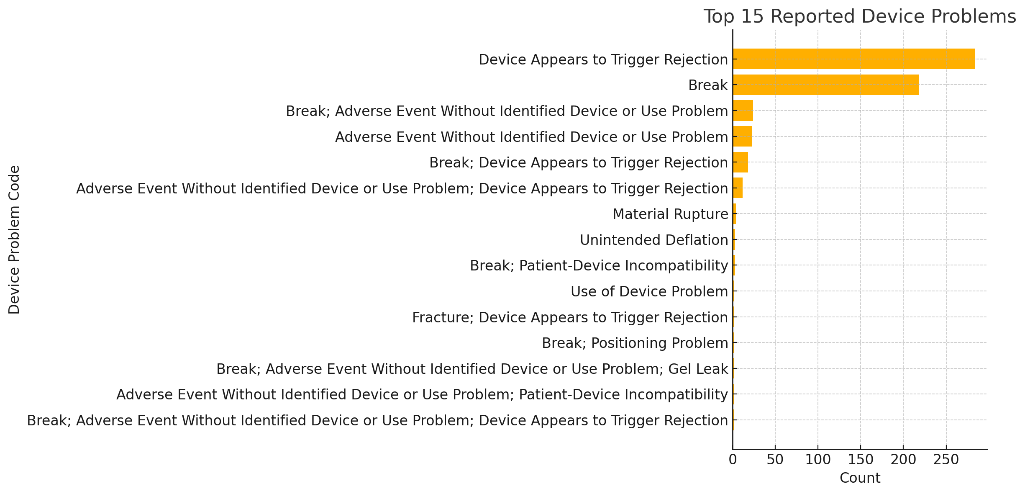 Figure 2: Top 15 Reported Device Problems
Identifying ruptures provides insight into the potential failure rate of the device, which the manufacturer represented as 0.6% in its PMA application.[170] If postmarket data reveal a concern, the manufacturer may have to update its label, which could impact sales. Distortions decrease the probability that regulators will identify a trend and take action.
Distortions can also arise when injuries are misclassified as a malfunction, making it more difficult to detect serious harms. When reported, manufacturers must classify each adverse event into one of three categories: malfunction, serious injury, or death.[171] If an event is classified as malfunction instead of death, it will be harder to find. For example, catheters or ports may break and migrate to other areas, such as the heart. Manufacturers may submit these as “malfunctions” despite the injury caused to the patient.[172] In one report classified as “malfunction,” the manufacturer stated that “[a] pre-procedure x-ray determined the catheter had detached from the port and migrated to right atrium . . . catheter was removed using a snare via groin access.”[173]
Although a malfunction occurs when “device [fails] to meet its performance specifications or otherwise perform as intended,”[174] it may also result in a serious injury: one that “[n]ecessitates medical or surgical intervention to preclude permanent impairment of a body function or permanent damage to a body structure.”[175] Under this definition, a catheter that migrates to another part of the body and requires further intervention is a serious injury. Given the choice between these two categories, a rational manufacturer may report a broken catheter as a malfunction rather than a serious injury because it reduces the probability of regulator detection. In short, manufacturers have incentives to select the reporting category that seems least serious.
Misclassifications may occur through reclassification even after an initial correct classification. Reclassification occurs when a manufacturer initially reports an event as death, but then later reclassifies it as a serious injury or malfunction based on new information. For example, a manufacturer filed a report classifying an adverse event as death when its device failed to alarm and the patient died.[176] Later it reclassified the death as “serious injury” because “the user has confirmed that the patient did not die but survived in critical condition”[177] even though the manufacturer “finally received the information that the patient expired at the end.”[178] In another case, a manufacturer down classified a death to serious injury even though a patient died because it concluded the device did not cause the death.[179] There are other examples.[180] The net effect of these reclassifications is to potentially obscure the significance of safety signals in the data.
Finally, some distortions can occur because adverse events are non-coded: they are coded as not related to the device or some other miscellaneous category. For instance, one manufacturer reported device problems as “Adverse Event Without Identified Device or Use Problem (2993)” and “Patient Problem” as “No Clinical Signs, Symptoms or Conditions (4582)” yet the report “summarize[d] 542 death events.”[181]
A similar problem occurs when the product model field is reported as “unknown.” If an epidemiologist attempts to search for a vagal stimulator with an “unknown” product field, for example, they will not be able to link the device to a particular manufacturer. Without knowing which device malfunctioned, the adverse event reports are not useful for identifying safety problems with particular devices.
4. Mischaracterizing or Assuming Causality.—Because reporting entails interpreting the cause of an event, manufacturers distort by suggesting someone or something other than the device that caused or contributed to the injury. For example, in one report the manufacturer concluded user error was possible but a problem with the device was not because “a systematic issue with design and/or material properties would have been detected as part of the issue evaluation assessment defined in complaint investigation.”[182] In another report, a manufacturer concluded that it is “not conceivable” that its device could cause the adverse event [endocarditis] and that the injury was from “patient factors,” even though “at this time the exact root cause of the reported endocarditis cannot be determined.”[183] Still another report blamed a potential kinked stent on user error because the physician did not visually inspect the device before using it.[184]
Sometimes this behavior can be extreme. In one lawsuit, for example, the plaintiff alleged that the device manufacturer systematically distorted event reports, “blaming the problem on everything but the defective product.”[185] In other cases, causation may be genuinely unknown, but the manufacturer assumes that the absence of evidence is evidence of absence. For example, a manufacturer of a hip implant assumed that the device was not the cause of the death (and downgraded the event to serious injury), but had insufficient information to make that conclusion.[186]
5. Summary Reporting & Exemptions.—Another way distortions arise is through reporting exemptions, variances, or alternative forms of reporting (collectively exemptions).[187] Exemptions can obscure data in different ways. One is to hide data entirely. For example, from 1999–2019, the FDA granted exemptions to manufacturers reporting under the Alternative Summary Reports (ASR) program.[188] Under the program, manufacturers could submit summary reports of adverse events rather than individual reports. For example, Medtronic submitted a summary report of 693 reported events for Device Problem “Adverse Event Without Identified Device or Use Problem (2993)” and Patient Problems “Erosion (1750); Unspecified Infection (1930); Pocket Erosion (2013).”[189] Over 5 million adverse event reports were hived off in the non-public ASR database,[190] leaving the public and many officials at the FDA in the dark.[191] Because information about adverse events was typically not known to anyone inside or outside the FDA, the reported information could not function as an “early warning” system.[192]
Exemptions can also distort by lumping reports together, making it more difficult to identify safety events attributable to one device through standard searching techniques. Consider the Voluntary Manufacturer Summary Reporting Program (VMSR). Unlike the ASR, the VMSR allows manufacturers of eligible devices to report malfunctions on a quarterly basis.[193] If summary reports are harder to parse than individual reports, they can obscure safety signals and decrease the probability regulators will identify them.
Besides the VMSR, the FDA continues to grant exemptions from reporting requirements under a variety of circumstances, such as when the company asserts the device is subject to litigation[194] or implicates trade secrets.[195] For example, Intuitive Surgical submitted a summary report under a litigation exemption for allegations of injuries received during a lawsuit.[196] And Boston Scientific reported “151 reported incidents for ureteral stricture” under “Exemption/variance number: rwd2400413.”[197]
Another type of exemption is for device registries that collect so-called “Real World Data.”[198] Registries may be part of a broader research and commercialization strategy. For example, registries may be required for reimbursement by Medicare as part of coverage with evidence development.[199] In exchange for the manufacturer tracking the use of and outcomes associated with a device at a specific clinical site, CMS reimburses the manufacturer for certain costs associated with the use of the device. A device registry exemption from the FDA enables a manufacturer to submit summaries instead of individual reports instead.[200] For example, Medtronic received an exemption to summary report events from a registry for its Watchman Left Atrial Appendage Closure device.[201] Instead of reporting adverse events associated with the Watchman within the timeframes stated in Figure 1, Medtronic can report batches of adverse events for devices in the registry.[202]
6. Flooding the Zone.—Manufacturers may also distort data by “flooding the zone”: overloading reports with information or presenting information in ways that overload an observer’s ability to analyze it.[203] Reviewers who are unfamiliar with reporting or particular divisions—or those who are new—may require additional time to find relevant information or miss it entirely.
One method is to submit huge amounts of text reporting the results of studies done or found in the literature. Because the FDA interprets its regulations to cover any adverse events found in the literature or reports, manufacturers must file reports when adverse events appear in the literature.[204] But there is no requirement on how to format these reports, and manufacturers dump them all into plain text.
Another tactic is to use disclaimers and exculpatory language that make it more difficult to sift through the information in the report. For example, the narrative section of the report from Johnson & Johnson describes the incident this way:[205]
 Figure 3: Manufacturer Narrative from Adverse Event Report
None of this is relevant.
Additionally, manufacturers may include extraneous information about legal reporting obligations and liability. For example, they may quote or state sections of the Code of Federal Regulations or disclaim liability:[206]
By definition, reporting is done to comply with the Code of Federal Regulations. And the reporting form already explicitly states that reporting does not constitute an admission of liability.[207]
 Figure 4: Manufacturer Narrative from Adverse Event Report
These additions can pollute the text of a report, especially when repeated across tens or hundreds of reports.
Another example: Manufacturers will include instructions for use (IFUs) in the manufacturer narrative field, making it more difficult for a reviewer to determine what happened. For instance, in one report from Cook Medical, the “manufacturer narrative” includes significant portions of extraneous information:[208]
 Figure 5: Manufacturer Narrative from Adverse Event Report
The technique is not limited to one manufacturer[209] or one type of product. For example, the narrative below describes an issue with an Automated External Defibrillator:[210]
 Figure 6: Manufacturer Narrative from Adverse Event Report
Another example concerns a clip detached from a “sling” used for transporting patients:[211]
 Figure 7: Manufacturer Narrative from Adverse Event Report
This last example illustrates how the instructions for use can influence how the FDA interprets the data.
Finally, some manufacturers may cut and paste identical information hundreds of times. For example, one manufacturer’s MDRs result from its own retrospective study.[212] The manufacturer narrative is a condensed version of the study that is incredibly difficult to parse:
 Figure 8: Excerpt of Manufacturer Adverse Event Report
Although the event description text provides study information in a more digestible form, the same results are copied and pasted 542 times, occupying 479 pages:[213]
 Figure 9: Excerpt of Manufacturer Adverse Event Report
Reporting the text in isolation is confusing enough; reporting it 542 times can be disorienting as reviewers must sift through all the information to ensure it contains nothing new. In fact, this defeats the dual purposes of summary reporting: to streamline reporting and review a significant number of adverse events.[214]
C. Why Distortions Matter
Although the distortions described in this subsection can reduce the manufacturer’s expected penalty, they also impose negative externalities. One is injury to patients. By reducing the likelihood regulators will identify safety signals, distortions may delay or eliminate regulatory action to reduce the harms caused by unsafe devices. For example, manufacturers that use aliases make it more challenging for regulators to identify patterns for devices from a single manufacturer. Or they may use summary reporting to reduce the probability that particular adverse events are identified, tracked, and analyzed. When distortions delay pulling the device from the market for two years, for example, patients suffer two years of injuries that would not have occurred with undistorted data.
Importantly, the effects of distortions are cumulative. An individual distortion is unlikely to create a significant problem. Miscoding a single adverse event—e.g., coding a breast implant rupture as a break—may have a negligible effect in a dataset of thousands of properly coded adverse events. But repeatedly miscoding events this way—or doing so sporadically—can make it more challenging to identify patterns in the data. For instance, repeatedly classifying breast implant ruptures as “breaks” makes it more challenging for those searching a database to identify the problem with the device. The same thing is true when a manufacturer reports a serious injury as a malfunction—or down-classifies deaths to malfunctions.
Adding other types of distortions—such as flooding the zone and using inaccurate product codes—exacerbates the problem. The more distortions alter the reliability and consistency of search results across fields, the harder it becomes to link related adverse events. Thus, increasing the number and types of distortions is likely to increase the probability that regulators delay, or never take, preventative or remedial actions with respect to unsafe medical devices.
In addition to regulator delays or inaction, distortions can raise costs for other actors in the healthcare system. Insurers that reimburse for unsafe devices may pay twice—first for a device that is unsafe and second for medical intervention required by the injury caused by the device.[215] Patients face similar double costs, in addition to the physical and emotional costs of the injury. Additionally, physicians may bear costs of malpractice lawsuits in cases where the device does not meet the existing standard of care but has been promoted either on- or off-label by manufacturers.[216]
Finally, distortions can negatively affect innovation. Because the device ecosystem is both iterative and reliant on existing devices for market entry, failure to identify unsafe devices may lead to low-quality innovation. If regulators cannot identify unsafe devices, or can do so only poorly, future innovations may iterate on them. Innovators relying on unsafe devices are at risk of iterating new, unsafe devices.
Amplifying this risk is the 510(k) clearance process, which allows devices to reach the market by demonstrating substantial equivalence to a predicate device.[217] Because of this reliance, unsafe devices can have effects beyond those discussed above. For example, when a new device relies on a predicate that has been recalled, the new device is more likely to be recalled.[218] Given that almost all devices are cleared through 510(k), even a small number of unsafe devices could create ripple effects through the system.[219]
Regardless of the method of device authorization, leaving unsafe devices on the market can push innovation toward unsafe devices, driving scientific research in counterproductive directions.[220] A decline in innovation quality would mean increased costs in the forms already described. But it would also divert resources from more promising innovations. And it may skew already scarce federal health dollars toward the wrong kind of research.
III. Reducing Data Distortions
Data distortions have significant implications for public health, patient safety, and medical innovation. This Part describes and analyzes how to reduce them by increasing expected penalties through legislation (section A), regulation (section B), litigation (section C), and the market (section D). Each mechanism can be used to increase expected penalties for distortions in three ways: (1) by reducing compliance costs, (2) by increasing the manufacturer penalty, and (3) by increasing the probability of detecting a violation. The proposals discussed use various regulatory tools, including precise reporting requirements (reducing manufacturer “wiggle room”), default-penalty rules, incentives for compliance, increasing regulator resources for inspection and enforcement, and decreasing regulatory costs through improving processing power.
A. Legislative Mechanisms
Congress could use legislation to influence manufacturer behavior by either decreasing the costs of compliance or increasing expected penalties. To reduce compliance costs, Congress may provide special incentives for strict compliance with the MDR Regulation.[221] For example, Congress could create a voucher system that rewarded compliant manufacturers. By performing exceptionally well, manufacturers could receive a transferable voucher that entitles the holder to expedited device review.[222] To induce manufacturers to seek a voucher, the compliance costs to obtain the voucher should be less than the value of the voucher. Because vouchers would have market value, the primary (though tractable) question would be how to set the time value of the voucher.[223] Alternatively, Congress could provide special reimbursement incentives for manufacturers that perform well. For instance, it could direct the CMS and FDA to develop a phased, graduated reimbursement program for particular devices when manufacturers comply with strict requirements under the MDR Regulation.
To increase expected penalties, Congress has two options. The first is to increase the likelihood or severity of penalties.[224] For example, Congress could make violations easier to prove. It might narrow the safe harbor for “significant or knowing departure[s],”[225] providing a lower threshold of proof. Repeated violations of a certain number or type could be sufficient to establish “significant or knowing departures” from the MDR Regulation. Or Congress might institute a default penalty rule, which requires manufacturers to prove compliance. It could fold in reduced penalties for noncompliance when preidentified actions have been taken. While the latter forces compliance, it also imposes costs on regulators who must review the data to assess compliance.
Congress might also increase the penalties associated with particular types of data distortions, mandating minimum fines or jail time. For example, it might create stronger penalties for reclassifications, downgrading classifications, or filing reports late—a particularly acute problem among manufacturers.[226] Perhaps repeated and significant distortions could trigger revocation of marketing authorization.[227]
The second option is to increase the probability of detection: The more likely a violation is detected, the more likely it is successfully enforced, increasing the expected penalty. Since probability of detection depends on how the violation is defined, Congress could grant the FDA authority to more precisely define reporting obligations in regulations or expand the types and nature of reporting requirements.[228] More precise definitions or expansive reporting requirements reduce ambiguity, which would constrain manufacturers from certain types of distortions and increase regulator’s ability to detect distortions.
Congress might also increase the FDA’s detection capabilities by providing more power to the FDA. For example, it might enable the FDA to require manufacturers to collect, investigate, and provide information about adverse events. Increased inspections and audits may increase expected penalties and deter distortionary practices. They may also ferret out noncompliance by reducing information asymmetries between manufacturers and regulators.
Additionally, Congress could increase resources for regulator monitoring and enforcement. With more funding, the FDA or outside researchers could spend more time evaluating data to identify distortions, increasing the probability that regulators identify and successfully enforce distortions. This could be done directly by appropriating new funding to the FDA or by specifically funding extramural research through the NIH or other private entities.[229]
Having more eyes on manufacturers and MAUDE, however, may not be sufficient to increase expected penalties—or at least it may come at a cost. And the cost of increasing regulator budgets may outweigh the benefits of increased monitoring and detection. For example, Congress may allocate $10 million to the FDA for monitoring and enforcement, but the benefit from the FDA’s activity may result in only a $3 million benefit (say, in prevented harm).
Understanding the costs and benefits of increased monitoring and enforcement budgets requires generating new information. Here the Government Accountability Office (GAO) could be helpful. It has a long history of important, nonpartisan, and thorough work, particularly with the medical device adverse event reporting.[230] If Congress passed legislation or used an appropriations rider, it could direct the GAO to audit the medical device reporting program and estimate the proposed benefits from reforming it. Alternatively, Congresspeople could form committees that request a GAO report. Congress could then take specific action based on those reports. Additionally, the Congressional Budget Office could also analyze reforms proposed in budget reconciliations. It would be particularly well-positioned to estimate the costs and benefits of both existing practices and any reforms. Finally, the Office of Information and Regulatory Affairs—within the Office of Management and Budget—could do cost–benefit analysis of proposed regulations.[231]
Even if no serious cost–benefit analysis is required or completed, policymakers should consider the dynamic effects of any legislative change. Manufacturers may respond by increasing prices to account for new compliance costs. Or manufacturers may produce more devices that are likely to generate adverse events that are excluded from reporting obligations. Another possibility is that manufacturers shift investment to other aspects of their business or to non-devices entirely.
In addition to increasing monitoring and enforcement, legislation could also impose costs on manufacturers by improving data quantity and quality. More and better data are harder to distort than isolated incidents. Additional sources of data also make it easier to cross-reference and validate reported information. Expanding the pool of mandatory reporters could have both effects. Consider the Medical Device Guardians Act.[232] Introduced in 2019, the bill extended medical device reporting requirements to physicians and physician offices.[233] While imposing costs on manufacturers was not the goal, that could have been the effect. If successful, physician reporting could have provided quality information to help offset some data distortions.
New reporters, of course, may also distort data. Like manufacturers, physicians have incentives to obscure safety information. If the physician, rather than the device, is to blame, the physician has an incentive to make this information more costly to obtain.[234] This suggests that mandating additional reporters may not help and could hurt. If physicians and manufacturers have similar incentives to distort, the data from the former is unlikely to be better than the data from the latter. But this may not be universally true. Additional information may sometimes be useful, especially if consistent. Imposing criminal penalties on the additional reporters for distortions might improve data quality, though it may have unintended effects on physician behavior. In the end, there is at least a question of whether more is better.
Whatever approach it takes, flexible legislation, implemented by the FDA, is probably the most effective way to address what are sure to be evolving manufacturer reporting techniques. The most important aspect of the legislation is ensuring that the law anticipates and provides a mechanism to respond to changes in manufacturer behavior. Of course, if the law has significant negative effects—like driving devices from the market or stagnating device development—Congress may be forced to reevaluate this approach.
B. Regulatory Mechanisms
While Congress has the most power to change expected penalties, the FDA can also impose or reduce costs through additional regulation. Like with Congressional action, the FDA could regulate in ways that seek to restrict the ability to distort by precising definitions—though its authority to create new requirements is limited. It, along with the DOJ, could also enforce violations more frequently, particularly those that are common, such as late filing. Here, of course, there are real resource constraints.
Another, less costly option for regulators is the use of guidance documents. The FDA uses guidance documents to project its “current thinking” on various topics, including MDR Regulation reporting obligations.[235] The FDA could issue more comprehensive guidance about how to report adverse events, including best practices that address the data distortions identified in this Essay. In other words, guidance documents offer a low-cost method of increasing detection by (1) restricting manufacturer ability to distort and (2) increasing the FDA’s processing power and, hence, ability to detect distortions. One downside of this approach is that it is nonbinding and may be open to more sustained legal challenge.[236]
Regulators can also reduce processing costs, and increase detection by revising Form 3500, the form manufacturers use to report adverse events.[237] Modifying the form may improve searchability. For example, the FDA recently made a change to how manufacturers should insert fields into Form 3500A when participating in the VMSR.[238] As a result, it is easier to search for device malfunctions reported in quarterly summaries. To help with search and data gathering, the FDA could create new categories for types of reports, including for reporting scientific literature, registry results, and individual adverse event reports. It might also experiment with additional or different fields to make reporting more uniform and useable. Finally, eliminating the use of paper forms could reduce data distortions that can occur when forms are not completed correctly. Electronic forms, for example, can prevent checking multiple boxes and similar errors. Requiring them may make a difference at the margins.
Finally, technology, such as artificial intelligence (AI), can reduce information costs for regulators. By making it easier for regulators to sift through and analyze data, AI could increase the expected penalty for manufacturers: It is easier both to extract relevant information (regulator costs decrease) and to identify bad actors (probability of detection increases). The government has already begun rolling out AI across a range of agencies, though its use predated the current administration.[239] While not all of these decisions are defensible or prudent, medical device reporting is a sensible place to start testing the use of AI. If trained properly on the existing datasets of MDRs and medical literature, AI could make it much less costly for regulators to identify trends in the data and sort out extraneous information from important information.
Of course, it would be unwise to roll out an AI simply because it could reduce information costs for regulators. It is also possible that a bad tool is worse than no tool at all—false positives and incorrect analyses can increase regulator costs, rather than reduce them. Therefore, the FDA would need to develop a pilot program to validate the concept, and eventually the AI tool, prior to relying on it to perform significant analytical work. If efficacious, however, the AI tool could significantly reduce costs associated with distorted data. Additionally, AI may be able to detect new types of data distortions as they arise, flag them for reviewers, and provide additional analyses that can form the basis for further reviewer work or investigations.
C. Litigation Mechanisms
Lawsuits can also discourage data distortions by increasing expected penalties—both in frequency and size. For example, private regulators (plaintiffs’ attorneys) could pursue new theories of liability for distortions under state law. These theories would have to address the challenges of existing private actions, such as tort claims for design or warning defects. Warning defect claims, for instance, require establishing a preexisting state law duty to report to the FDA—a task that has proved challenging.[240] That is to say nothing of other defenses, such as preemption or standing.[241]
Any new theory of liability will also have to confront the legal differences between device types. For PMA devices, the claims must be premised on some preexisting state law duty.[242] For 510(k) devices, a freestanding theory of liability alone may be enough, though it cannot be based only on a distortion or failure to report.[243]
One option is traditional misrepresentation or fraud claims. The core element of these claims is that manufacturers are misrepresenting the risks associated with devices by concealing them or reporting them in a deceptive manner.[244] This theory, however, faces challenges. Distortions may not be completely inaccurate, or they may seem relatively minor to a judge or jury. Additionally, the heightened pleading standards for fraud claims may knock out cases before they can get to the discovery stage.[245]
Because of these difficulties, a new theory of liability may provide a better option. Existing law provides some helpful analogues. Overpromotion, a variant of a failure-to-warn claim, is one.[246] In a traditional failure-to-warn claim, the plaintiff argues that the manufacturer did not adequately disclose a device’s risks to the treating physician. Because the physician would not have used the device if the manufacturer had provided risk information, the manufacturer is liable for the patient’s injuries caused by the device. In some contexts, however, the manufacturer may have disclosed the risks but drowned out the risk information by heavily promoting the product’s benefits.[247] Plaintiffs have successfully argued that this “overpromotion” undercut the disclosure of risk information.[248] Failure-to-warn claims could proceed because even though warnings had been provided, the manufacturer’s promotional activities rendered them legally insufficient.
Distortions could be the basis for a failure-to-warn claim on a theory similar to overpromotion: a manufacturer may have warned of risks by reporting them, but data distortions canceled out, diminished, or obscured the risk information that would influence a physician’s decision. By making it difficult to sift through and find relevant risk information, manufacturers are offsetting or obscuring risk information disclosed in the adverse event reports.
Notably, this theory would not hinge on any duty to report to the FDA;[249] rather, it would focus on the duty to properly inform physicians of risk information once reported.[250] In other words, the relevant failure is to adequately inform based on reported information rather than failure to report the information in the first place.
The challenge for this type of claim is that it would require proving both that (1) the physician actually consulted MAUDE or sources that rely on MAUDE, and that (2) the physician would have changed her behavior based on the undistorted data. Unfortunately, there is limited evidence about whether and how frequently physicians use the MAUDE or other sources that rely on it. And there is even less information about how MAUDE influences physicians that consult it.
Although a plaintiff needs to find only a single physician who consults and relies on MAUDE data, the probability that the treating physician actually does so in any particular litigated case is low. And the fewer physicians who consult MAUDE, the less likely the plaintiff’s physician will have done so. That said, if the plaintiff can establish that her physician consulted MAUDE, distortions may be powerful. Since adverse events are underreported, reported information could be even more important to physicians that consult it.[251] Distortions that make it difficult to find and analyze the reported information could, therefore, have significant consequences. At the same time, however, it may be challenging to convey the significance of individual distortions to a jury. As a result, this type of claim faces formidable obstacles.
Challenges like these may drive claims away from manufacturers and toward physicians. Here novel theories of liability could, ironically, provide a foundation for claims against manufacturers. But a stepwise, sustained effort is required. Step one is to use malpractice liability to create an incentive for physicians to regularly use MAUDE. Plaintiffs could argue that physicians have a duty to consult MAUDE, and that their failure to do so constitutes negligence.[252] If the theory is successful, it could provide the substrate for claims against manufacturer distortions. In other words, the theory incentivizes physicians to consult MAUDE regularly, making it more likely any individual physician will consult MAUDE—potentially even creating a duty to do so. It also solves the problem of proving causation: The more physicians consult MAUDE, the more likely they are to change their behavior in response to the information they find in it.
New theories of liability may also stimulate market demand for information. For example, if physicians can be liable for failing to consult MAUDE data, firms may create easy-to-use databases that provide better search tools and visualizations. Others may create clinical practice guidelines that incorporate MAUDE data.[253] Or electronic health record and software firms may start building in the capabilities into physician and administrative workflows.
But there are problems. First, some courts have interpreted the reporting statute and regulations to prevent even the discovery of voluntary (physician and device user facilities) and mandatory device user facility MDRs.[254] For example, the Eighth Circuit held this language means that individual mandatory reports by device user facilities may not be discoverable in litigation or admissible once discovered.[255] However, it does not prevent discovery or admission of manufacturer MDRs.[256] In other words manufacturer reports can still be discoverable, but any underlying physician or device user facility MDRs to the manufacturer typically are not. Without discovery of device user facility MDRs, plaintiffs’ claims may be harder to prove.
Despite this problem, most courts do not follow the Eighth Circuit’s rule. Some hold that the discovery prohibition applies only when the reporter (i.e., the physician or the device user facility) is the defendant.[257] Thus, plaintiffs can discover and admit into evidence both voluntary (physician and device user facility) and mandatory (device user facility) reports and the “complaint files” created and maintained by the manufacturer in response to them.[258]
Perhaps the most significant challenge is motivating plaintiffs’ attorneys to test new theories of liability on physicians. Claims involving adverse event reports, for example, are typically based on the manufacturer’s failure to report rather than to distort.[259] Worse, if jurisdictions follow a custom-oriented standard of duty, then proving that the physician had a duty to check MAUDE may be difficult. Finally, some plaintiffs’ firms separate their malpractice and products liability practices for strategic reasons,[260] making it difficult to stitch claims across practices. All this suggests an uphill battle for a new theory of liability.
D. Market Mechanisms
Market mechanisms could also be used to increase costs of distortions by reducing information and comprehension asymmetries between manufacturers and regulators/medical professionals.[261] By forcing manufacturers to internalize the costs of distortions, market mechanisms effectively raise the expected penalties associated with them. For example, third parties could rate medical devices based on the distortions they find in MAUDE data. Grades could be assigned based on the nature and quantity of distortions. Manufacturers with the best rating will be those that distort the least, and vice versa. To be effective, this information must be conveyed to interested parties like hospital systems, insurers, physicians, and patients. If any of these parties value the information, the market will provide it to them, perhaps in the form of something like Consumer Reports. The result: Manufacturers with low ratings will sell fewer units than those with higher ratings.[262]
Certification or certification marks might help if ratings have little uptake. Certification marks provide assurance that a product or service meets certain standards set by the certifier.[263] Sellers reduce information costs for buyers by providing information that is otherwise difficult to verify. If purchasers and users of medical devices care about compliance with MDR Regulation, then a certification mark may provide useful information to them. Purchasers that want to ensure that device manufacturers are not hiding or obscuring information—and hence were more confident in their products—could select devices that had been certified as MDR Regulation, non-distortion compliant by an independent organization. This organization could certify various aspects of the reporting process, including proper training and reporting techniques. It could also validate a manufacturer’s reporting to ensure they are free from distortions. It may even have access to better information than the FDA if manufacturers provide additional data to the certifier on a confidential basis.
Of course, even the best rating system or certification mark will not necessarily convey complete information about device risks. MAUDE data are woefully incomplete.[264] And ratings or certifications based on distortions alone may not be sufficient to generate market interest. Consumers of information about reporting habits, however, may value information about underreporting more generally. Even if these are folded into ratings or certification systems, they are unlikely to compensate for the limited data in MAUDE.
While imperfect information may be better than no information, the market for this type of information appears limited. There are no certification marks[265] or bodies that provide information to consumers about device reporting. To the extent firms exist in this domain, they seem directed at manufacturers[266] (or attorneys).
Markets may arise in different ways. One is through litigation, mentioned above. Another is for the government to require certification, as it does in other areas.[267] In this circumstance, the government could create an accrediting organization that grants certification authority to entities. Manufacturers would then obtain certification from accredited certifiers.
While many government certification programs are mandatory (e.g., certification is often required for participation in a government healthcare program), not all are. Voluntary certification programs incentivize participation through some other means, such as fewer bureaucratic tangles. In the MDR context, the FDA could offer inducements like fewer inspections focused on device reporting, less searching review of adverse event reports, or different reporting obligations (e.g., more summary reporting). These might spur voluntary compliance with certification programs, improving the quality of information about device reporting.
The real question is whether setting up a market for certification would improve reporting. Instead of increasing the cost of the expected penalty, certification would reduce the expected penalty by increasing compliance. Predicting whether a certification program would materially alter manufacturer behavior, however, is difficult. Additionally, certification has its own set of problems, including poorly developed standards, anticompetitive practices,[268] and counterproductive competitive pressures.[269] While it may not be ideal, certification is one potential option to reduce data distortions.
Markets can also be created to forecast events. Prediction markets are an example.[270] In a prediction market, buyers and sellers can trade contracts “whose payoff depends on unknown future events.”[271] Kalshi, for example, enables users to place bets on contracts about “inflation, to fed rates, to unemployment, to will the government shut down,” among thousands of options.[272] A similar market could be constructed for adverse event reports. Users could place bets on manufacturer reclassifications, event description accuracy, future regulator actions, or future litigation. Prediction markets could provide insight into what manufacturers and device types are most likely to distort—and what form those distortions could take. Predictions, in turn, could inform regulator action.
Market mechanisms can also reduce costs for regulators by leveraging randomization.[273] For example, regulators might randomly select a portion of reports to analyze and impose steep fines on violators. Companies could be required to have sufficient assets to pay a fine, effectively creating a new insurance market. Random selection ensures that each manufacturer report has an equal chance of being selected, reducing the probability that it will distort in any given report. Insurance markets can price in risk for distortions. Pricing will reveal information about the expected frequency of distortions and the costs they impose. Manufacturers will adjust behavior in the shadow of this risk.
E. What’s Best?
None of these approaches, by themselves, is likely to solve the distortionary problem. Some mixture of them is likely to help. Because some of the calculations require better understanding the costs of the existing system, more research is needed to determine the optimal course of action. However, given the significant rate of underreporting and the significance of distortions in limited data, Congress or the FDA should take at least two actions. First, expand mandatory reporting to those with relevant information, such as physicians, nurses, and staff. Second, increase penalties for distortions in line with the suggestions above. Doing both will improve the representativeness of the data and its quality.
Conclusion
By requiring that information be produced, law often requires firms to generate information that would otherwise not exist.[274] Yet how firms present this information can significantly affect whether the law serves its intended goals. In other words, data presentation can impede law’s information production. Using the example of medical device reporting, this Essay showed that data producers can have two different economic incentives to distort data by reducing expected penalties: one to affirmatively distort, and another to be indifferent to distortions. It then offered several strategies to reduce distortions by increasing expected penalties. It concluded that the best approach was probably a mix of strategies that involve using legislation, regulation, and markets to influence manufacturer reporting behavior.
- . Data here means information about particular activities that regulated entities are legally required to generate, collect, monitor, or analyze. ↑
- . Zachary D. Clopton & Aziz Z. Huq, The Necessary and Proper Stewardship of Judicial Data, 76 Stan. L. Rev. 893, 906–07, 909 (2024). ↑
- . Not all of the disclosed information is public. For example, private offerings under Regulation D can require disclosure to investors but not the public more generally. E.g., 15 U.S.C. § 77d(a); 17 C.F.R. § 230.506 (2025); 17 C.F.R. § 230.502(b)(1) (2025). Some exempt transactions still require public disclosure under state law. E.g., 815 Ill. Comp. Stat. 5/4(G) (1953). ↑
- . See, e.g., Assaf Jacob & Roy Shapira, An Information-Production Theory of Liability Rules, 89 U. Chi. L. Rev. 1113, 1117 (2022) (describing the role of tort’s negligence standard in injecting quality information into the market); Assaf Jacob, Yotam Kaplan & Roy Shapira, An Information-Production Theory of Contract Law, 109 Iowa L. Rev. 603, 607 (2023) (arguing that the role of fault in contract law is to produce information); Rebecca S. Eisenberg, The Role of the FDA in Innovation Policy, 13 Mich. Telecomms. & Tech. L. Rev. 345, 347 (2006) (explaining how drug regulation develops credible information about drug effects). ↑
- . Janet Freilich, Law as a Lamppost, 110 Iowa L. Rev. 1647, 1649 (2025). ↑
- . The most closely related and comprehensive treatment of this subject is by Wendy Wagner. Professor Wagner identifies the fundamental problem as “comprehension asymmetries,” which “arise when one party has a greater ability to understand or process the relevant information relative to his or her conservational partner.” Wendy Wagner with Will Walker, Incomprehensible!: A Study of How Our Legal System Encourages Incomprehensibility, Why It Matters, and What We Can Do About It 7 (2019). See generally Susmitha Wunnava, Timothy A. Miller & Florence T. Bourgeois, Improving FDA Postmarket Adverse Event Reporting for Medical Devices, 28 BMJ Evidence-Based Med. 83 (2023) (identifying potential ways to avoid misclassification and inconsistent reporting in the FDA’s MAUDE database); Janet Freilich & Michael J. Meurer, Reinventing Patent Prosecution (Nov. 5, 2025) (unpublished manuscript) (on file with author) (discussing procedural reform to reduce information asymmetry between patent agents and applicants). ↑
- . William M. Sage, Regulating Through Information: Disclosure Laws and American Health Care, 99 Colum. L. Rev. 1701, 1710–12 (1999). ↑
- . See generally Arthur G. Fraas & Randall Lutter, How Effective Are Federally Mandated Information Disclosures?, 7 J. Benefit-Cost Analysis 326 (2016) (suggesting that federal disclosure mandates be evaluated for effectiveness of improving comprehension); Omri Ben-Shahar & Carl E. Schneider, More Than You Wanted to Know: The Failure of Mandated Disclosure 3 (2014) (detailing mandated disclosure as the “least successful regulatory technique”). The authors are primarily interested in legally mandated disclosures directed toward retail consumers. Other, previous work was not so focused and includes many of the data that this Essay discusses. See, e.g., Archon Fung, Mary Graham & David Weil, Full Disclosure: The Perils and Promise of Transparency (2007) (examining if targeted transparency is a productive governance practice). ↑
- . Disclosures, of course, are data in the general sense. And some of the data I discuss here could be described as disclosures. ↑
- . Robert J. Bloomfield, The “Incomplete Revelation Hypothesis” and Financial Reporting, 16 Acct. Horizons 233, 233–44, 238 (2002); Feng Li, Annual Report Readability, Current Earnings, and Earnings Persistence, 45 J. Acct. & Econ. 221, 238–39 (2008). ↑
- . Kathleen M. Fagan & Michael J. Hodgson, Under-Recording of Work-Related Injuries and Illness: An OSHA Priority, 60 J. Safety Rsch. 79, 79–80 (2017). ↑
- . Fagan & Hodgson, supra note 11, at 80; see, e.g., Comm. on Educ. & Lab., U.S. House of Representatives, Hidden Tragedy: Underreporting of Workplace Injuries and Illnesses 23 (2008) (noting that injuries to cleanup workers hired by meatpacking plant were reported in a lower-risk category (housecleaners) instead of a high-risk category (meat-packing industry) and observing the more general problem of misclassification as independent contractors). Like with the distortions in this paper, there are several potential causes. Employers may intentionally misdescribe or pressure employees to do so—or reporting employees may simply be ignorant of how to properly report. ↑
- . U. S. Gen. Acct. Off., GAO/PEMD-89-10, Medical Devices: FDA’s Implementation of the Medical Device Reporting Regulation 2, 5, 10, 18 (1989), https://www.gao.gov/
products/pemd-89-10 [https://perma.cc/KCB6-JAR6]. ↑ - . The FDA proposed the original rule in 1980. Medical Devices; Mandatory Device Experience Reporting, 45 Fed. Reg. 76183, 76183 (proposed Nov. 18, 1980) (to be codified at 21 C.F.R. §§ 20, 803). The agency published the final rule in 1984. 49 Fed. Reg. 36326, 36326 (Sep. 14, 1984) (codified at 21 C.F.R. §§ 600, 803, 1002, 1003 (1984)). ↑
- . Lily Meier, Elizabeth Y. Wang, Madris Tomes & Rita F. Redberg, Miscategorization of Deaths in the US Food and Drug Administration Adverse Events Database, 180 JAMA Internal Med. 147, 147–48 (2020) (finding for Sapien 3 and MitraClip devices that the manufacturer used a variety of terms to obfuscate the death of patients, such as hospice and passed away, which led to miscategorization of adverse events); Christina Lalani, Elysha M. Kunwar, Madris Kinard, Sanket S. Dhruva & Rita F. Redberg, Reporting of Death in US Food and Drug Administration Medical Device Adverse Event Reports in Categories Other Than Death, 181 JAMA Internal Med. 1217, 1218–19, 1221 (2021) (finding the same result with random sample of 1000 adverse event reports). ↑
- . Wagner calls these “processing costs”: “The costs needed to make reasonable sense of information so that it can be used.” Wagner, supra note 6, at 14. ↑
- . For a review of the literature, see David A. Simon, Hooman Noorchashm & Michael Paasche-Orlow, Federal Malpractice (unpublished manuscript) (on file with author). ↑
- . Vinay K. Rathi, Harlan M. Krumholz, Fredrick A. Masoudi & Joseph S. Ross, Characteristics of Clinical Studies Conducted Over the Total Product Life Cycle of High-Risk Therapeutic Medical Devices Receiving FDA Premarket Approval in 2010 and 2011, 314 JAMA 604, 609–10 (2015). Typically only a single pivotal trial supports a device approval. Id. at 610. ↑
- . See, e.g., Diana Zuckerman, Paul Brown & Aditi Das, Lack of Publicly Available Scientific Evidence on the Safety and Effectiveness of Implanted Medical Devices, 174 JAMA Internal Med. 1781, 1782–83 (2014) (finding 26% of 50 “cleared for market” medical implants did not provide any scientific evidence of safety or substantial equivalence to prior cleared for market predicates); Alexander Y. Liebeskind, Amanda C. Chen, Sanket S. Dhruva & Art Sedrakyan, A 510(k) Ancestry of Robotic Surgical Systems, 98 Int’l J. Surgery 106229, 106229 (2022) (finding 27.9% of the sampled cleared for market devices presented no clinical data, instead relying solely on substantial equivalence to previously cleared medical devices, “most of which did not present clinical data”). For a summary of premarket clearance using predicates, see infra notes 24–26 and accompanying text. ↑
- . Brockton J. Hefflin, Thomas P. Gross & Thomas J. Schroeder, Estimates of Medical Device—Associated Adverse Events from Emergency Departments, 27 Am. J. Preventive Med. 246, 246 (2004) (estimating 454,383 adverse events associated with medical devices based on emergency department visits from July 1999 through June 2000). ↑
- . See Alberto Galasso & Hong Luo, Product Liability Litigation and Innovation: Evidence from Medical Devices 5, 21–22 (Nat’l Bureau of Econ. Rsch., Working Paper No. 32215, 2024), https://www.nber.org/papers/w32215 [https://perma.cc/UE8M-GBSK] (finding that public disclosure of adverse events increases the likelihood of litigation). ↑
- . 21 U.S.C. § 321(h)(2). ↑
- . 21 U.S.C. § 360c(a)(1)(A). ↑
- . 21 U.S.C. § 360c(a)(1)(B); Sara Gerke & David A. Simon, New Case Law and Liability Risks for Manufacturers of Medical AI, 388 Sci. 1138, 1138–39 (2025). ↑
- . 21 U.S.C. § 360(o)(1)(A). ↑
- . 21 U.S.C. § 360c(i)(1). ↑
- . 21 U.S.C. §§ 360c(a)(1)(C), 360e(a), 360e(d)(5)(B)(i), (ii). ↑
- . ↑
- . H.R. Rep. No. 94-853, at 23–24 (1976). ↑
- . Medical Device Amendments of 1976, Pub. L. No. 94-295, sec. 2, § 519(a), 90 Stat. 539, 564 (codified at 21 U.S.C. § 360i(a)). ↑
- . From 1976 to 1984, the FDA’s reporting system was focused on individual device problems and voluntary reports. See Statement of Eleanor Chelimsky, U.S. Gen. Acct. Off., GAO/T-PEMD-87-4, Medical Devices: Early Warning of Problems Is Hampered by Severe Underreporting 1, 10 (May 4, 1987), https://www.gao.gov/products/t-pemd-87-4 [https://perma.cc/Y2HN-T5ZT] (describing deficiencies in the old reporting regime); Medical Device Amendments of 1992, Pub. L. No. 102-300, sec. 5, § 519, 106 Stat. 238, 239 (amending 21 U.S.C. § 360i) (adding new reporting requirements). ↑
- . The FDA maintains twenty-seven separate databases relating to medical devices. See Medical Device Databases, U.S. Food & Drug Admin., https://www.fda.gov/medical-devices/device-advice-comprehensive-regulatory-assistance/medical-device-databases [https://perma.cc/MH2S-PQE8] (listing the FDA’s medical device databases). ↑
- . Until 1996, however, the FDA entered adverse event reports in the Medical Device Reporting Database (MDR), which is no longer actively updating data but still contains information from 1992 to 1996. MDR Database Search, U.S. Food & Drug Admin., www.accessdata.fda.gov/scripts/cdrh/cfdocs/cfmdr/search.CFM [https://perma.cc/X7F5-4K24]. The FDA published the Final Rule under the 1992 Amendments on December 11, 1995. Medical Devices; Medical Device User Facility and Manufacturer Reporting, Certification and Registration, 60 Fed. Reg. 63578, 63578 (Dec. 11, 1995) (codified at 21 C.F.R. §§ 803, 807). From 1984 to 1996 the Device Experience Network (DEN) captured mandatory reports, and from 1984 to June 1993 it captured voluntary reports. MDR Data Files, U.S. Food & Drug Admin., https://www.fda.gov/medical-devices/medical-device-reporting-mdr-how-report-medical-device-problems/mdr-data-files [https://perma.cc/R7PA-Z4EQ]. From 1997 to June 2019, the FDA also received manufacturer reports from the Alternative Summary Reports (ASR) program, which exempted some manufacturers from standard reporting obligations. Instead of reporting events under the standard time frames, the FDA allowed manufacturers to report on a quarterly basis. Memorandum from Director, Office of Surveillance and Biometrics to Manufacturers of Medical Devices, Center for Devices and Radiological Health, U.S. Food & Drug Admin. to Manufacturers of Medical Devices, Summary Reporting Approval for Adverse Events (July 31, 1997) [hereinafter Center for Devices and Radiological Health] (on file with author). ↑
- . David A. Kessler, Introducing MEDWatch: A New Approach to Reporting Medication and Device Adverse Effects and Product Problems, 269 JAMA 2765, 2767 (1993). ↑
- . MedWatch: The FDA Safety Information and Adverse Event Reporting Program, U.S. Food & Drug Admin., https://www.fda.gov/safety/medwatch-fda-safety-information-and
-adverse-event-reporting-program [https://perma.cc/R5W3-2JJV]. The FDA also maintains a database of all device recalls and early alerts. Medical Device Recalls, U.S. Food & Drug Admin., https://www.accessdata.fda.gov/scripts/cdrh/cfdocs/cfres/res.cfm [https://perma.cc/Y2TY-5QEN]. ↑ - . Marilyn Flack, Terrie Reed, Jay Crowley & Susan Gardner, Identifying, Understanding, and Communicating Medical Device Use Errors: Observations from an FDA Pilot Program, in 3 Advances in Patient Safety: From Research to Implementation 223, 223 (2005). MedSun is administered and operated by a third party contractor, which acts as a liaison between participating entities and the FDA. Id. at 224–25. ↑
- . The additional fields collected by MedSun are included in the MAUDE data. However, extraneous MedSun data that did not fit into the MAUDE fields was dumped into the manufacturer narrative. ↑
- . 21 C.F.R. § 803 (2025). ↑
- . 21 U.S.C. § 360i(a). Distributors of medical devices do not have reporting requirements but must maintain records of “incidents . . . that allege[] deficiencies related to the identity (e.g., labeling), quality, durability, reliability, safety, effectiveness, or performance of a device.” 21 C.F.R. §§ 803.1(a), 803.18(d)(1) (2026). ↑
- . 21 C.F.R. § 803.1(a) (2026). The Medical Device Amendments of 1976 required the FDA to propose reporting regulations for device manufacturers, importers, and distributors. Medical Device Amendments of 1976, Pub. L. No. 94-295, sec. 2, § 519, 90 Stat. 539, 564–65 (amending 21 U.S.C. § 360i). However, the FDA did not finalize these rules until 1984. Medical Device Reporting; OMB Approval and Effective Date, 49 Fed. Reg. 48272, 48272 (Dec. 12, 1984) (codified at 21 C.F.R. § 803). Congress mandated device user facility reporting in 1990. Safe Medical Devices Act of 1990, Pub. L. No. 101-629, sec. 2(a), § 519(b), 1044 Stat. 4511, 4511 (1990) (amending 21 U.S.C. § 360i). This law expressly directed the Secretary of HHS to promulgate reporting regulations. Id. sec. 2(b), 104 Stat. at 4512. At one point Congress required only a subset of device user facilities to report adverse events. Food and Drug Administration Modernization Act of 1997, Pub. L. No. 105-115, sec. 213(c)(5), § 519(b), 111 Stat. 2296, 2346–48 (amending 21 U.S.C. § 360i). ↑
- . Medical personnel use Form 3500 and consumers use Form 3500B. MedWatch Online Voluntary Reporting Form, U.S. Food & Drug Admin., https://www.accessdata
.fda.gov/scripts/medwatch/index.cfm [https://perma.cc/5UPJ-UEDE] (unifying previously separate voluntary adverse event reports from health care professionals). ↑ - . 21 C.F.R. § 803.50(a) (2025) (manufacturer); 21 C.F.R. § 803.40 (2025) (importer); 21 C.F.R. § 803.30 (2025) (device user facility). ↑
- . 21 C.F.R. § 803.50(a) (2025). Firms can request an exemption from reporting by analyzing data and showing the malfunction did not cause or contribute to the deaths or serious injuries reported. Exemptions, Variances, and Alternative Forms of Adverse Event Reporting for Medical Devices, U.S. Food & Drug Admin. (Mar. 27, 2025), https://www.fda.gov/
medical-devices/medical-device-reporting-mdr-how-report-medical-device-problems/exemptions-variances-and-alternative-forms-adverse-event-reporting-medical-devices [https://perma.cc/HTF6
-7AHE]. ↑ - . 21 C.F.R. § 803.50(b)(3) (2025) (duty to investigate); 21 C.F.R. § 803.56 (2025) (supplemental reports and follow-up reports). Manufacturers of a device with a PMA have annual reporting obligations that include adverse event information when a change to a PMA device was made as a result of an adverse event. Annual Reports for Approved Premarket Approval Applications, Food & Drug Admin. (Dec. 19, 2019), https://www.fda.gov/regulatory-information/search-fda-guidance-documents/annual-reports-approved-premarket-approval
-applications-pma [https://perma.cc/U5Y4-3HCU]; 21 C.F.R. § 814.82(a)(7) (2025). ↑ - . 21 U.S.C. 360i(a)(1)(b)(ii). The FDA has interpreted this as adding to, rather than replacing, the existing reporting requirements. Medical Device Reporting; Malfunction Reporting Frequency, 76 Fed. Reg. 12743, 12743–44 (Mar. 8, 2011); Medical Devices and Device-Led Combination Products; Voluntary Malfunction Summary Reporting Program for Manufacturers, 83 Fed. Reg. 40973, 40974 (Aug. 17, 2018). However, the FDA also piloted a program that allowed summary reporting for certain device malfunctions that displaced other requirements. Pilot Program for Medical Device Reporting on Malfunctions, 80 Fed. Reg. 50010, 50010 (Aug. 18, 2015) (outlining pilot program); Center for Devices and Radiological Health; Medical Devices and Combination Products; Voluntary Malfunction Summary Reporting Program for Manufacturers, 82 Fed. Reg. 60922, 60924 (Dec. 26, 2017) (proposal to grant alternative to mandatory reporting). ↑
- . 21 U.S.C. § 360i(b)(6)(A). ↑
- . 21 U.S.C. § 360i(b)(1)(B). ↑
- . MedWatch Forms for FDA Safety Reporting, U.S. Food & Drug Admin., https://www.fda.gov/safety/medical-product-safety-information/medwatch-forms-fda-safety
-reporting [https://perma.cc/N3CG-QLB8]. ↑ - . See regulations cited supra note 42. ↑
- . 21 U.S.C. § 360i(a)(1). ↑
- . 21 U.S.C. § 360i(a)(1)(A). ↑
- . 21 U.S.C. § 360i(a)(1)(B). ↑
- . 21 U.S.C. § 360i(b)(1)(A). ↑
- . Id. ↑
- . Id. ↑
- . Id. ↑
- . Id. ↑
- . 21 U.S.C. § 360i(b)(1)(B). ↑
- . Id. ↑
- . Id. ↑
- . Id. ↑
- . Id. ↑
- . U.S. Food & Drug Admin. (2026), https://www.fda.gov/safety/reporting-serious-problems-fda/reporting-health-professionals [https://perma.cc/8A89-JG6N]. ↑
- . The FDA has also issued a guidance document further explaining its current thinking on the MDR. See generally U.S. Food & Drug Admin., Medical Device Reporting for Manufacturers: Guidance for Industry and Food and Drug Administration Staff (2016), https://www.fda.gov/regulatory-information/search-fda-guidance-documents
/medical-device-reporting-manufacturers [https://perma.cc/88YX-N6LZ] [hereinafter Reporting Guidance]. ↑ - . 21 C.F.R. § 803.3(o)(1), (2) (2025). ↑
- . 21 C.F.R. § 803.3(w) (2025). ↑
- . 21 C.F.R. § 803.3(k) (2025). ↑
- . 21 C.F.R. § 803.3(o)(1), (2). ↑
- . See 21 C.F.R. § 803.3(b)(2) (defining awareness to include knowledge about a reportable event within 30 calendar days or an adverse event that would require remedial action to prevent unreasonable risk or substantial harm to public health). Guidance documents also stated that the FDA generally considers that a manufacturer becomes aware of an adverse event whenever “any employee becomes aware of information that reasonably suggests that an event is required to be reported.” Reporting Guidance, supra note 64, at 6. ↑
- . 21 C.F.R. § 803.3(b)(2) (2025). ↑
- . 21 C.F.R. § 803.50(a) (2021). ↑
- . 21 C.F.R. § 803.3(b)(2) (2025). ↑
- . 21 C.F.R. § 803.50(b)(1) (2021). ↑
- . 21 C.F.R. § 803.58(a) (2021). ↑
- . 21 C.F.R. §§ 803.3(o)(2), 803.50(a) (2025). ↑
- . 21 C.F.R. § 803.20(c)(1) (2025). ↑
- . Reporting Guidance, supra note 64, at 36. The instructions for using the reporting form state that “a copy of the manuscript must be attached.” U.S. Food & Drug Admin., General Instructions—Form FDA 3500A MedWatch (for Mandatory Reporting) 24 (2025) [hereinafter General Instructions]. ↑
- . 21 C.F.R. § 803.20(c)(2) (2025). ↑
- . Id. ↑
- . Reporting Guidance, supra note 64, at 35. ↑
- . Although the government can bring claims under the False Claims Act, I discuss these cases under private regulators. See infra subsection I(C)(2). Limitations are similar for both public and private regulators in each case. ↑
- . A fifth option is for state regulators to take action under state law. But see 21 U.S.C. § 360k (discussing limitations on state regulation). ↑
- . 21 U.S.C. § 331(q)(1)(B); see, e.g., Press Release, U.S. Dep’t of Just., Pentax Medical Company Agrees To Pay $43 Million To Resolve Criminal Investigation Concerning Misbranded Endoscopes (Apr. 7, 2020), https://www.justice.gov/archives/opa/pr/pentax-medical
-companyagrees-pay-43-million-resolve-criminal-investigation-concerning [https://perma.cc/WY8L-SUXT] (announcing a $43 million settlement after Pentax failed to file timely reports). ↑ - . 21 U.S.C. § 331(q)(2). ↑
- . 21 U.S.C. § 333(f)(1) (civil penalties); 21 U.S.C. § 333(a) (criminal penalties). ↑
- . Guidant LLC is currently a subsidiary of Boston Scientific. ↑
- . United States v. Guidant LLC, 708 F. Supp. 2d 903, 912 (D. Minn. 2010). ↑
- . United States Attorney Charges at ¶ 35, United States v. Guidant LLC, 708 F. Supp. 2d 903 (D. Minn. 2010) (No. 10-mj-67 DWF). ↑
- . See id. ¶¶ 47–50 (presenting the criminal charges); Guidant, 708 F. Supp. 2d at 908–09 (outlining terms of plea deal). ↑
- . Press Release, U.S. Dep’t of Just., Medical Device Manufacturer Guidant Sentenced for Failure to Report Defibrillator Safety Problems to FDA (Jan. 12, 2011), https://www.justice.gov/archives/opa/pr/medical-device-manufacturer-guidant-sentenced
-failure-report-defibrillator-safety-problems [https://perma.cc/WKV9-GX9V]. In a more dramatic example, the FDA brought charges against biopharma giant GlaxoSmithKline for failure to report adverse drug events as part of a larger case that involved off-label promotion and kickbacks. General Allegations at ¶¶ 83–95, United States v. GlaxoSmithKline LLC, No. 1:12-cr-10206-RWZ (D. Mass. July 2, 2012), https://web.archive.org/web/20120710231908/https://www.justice.gov/opa/documents/gsk/gsk-criminal-info.pdf [https://perma.cc/9G3R-H6DK]. ↑ - . 21 U.S.C. § 352(t)(2) (stipulating a device is misbranded for “failure or refusal . . . to furnish any material or information required by or under section 360i [the MDR Regulation] of this title respecting the device”). ↑
- . 21 U.S.C. § 352(a)(1). ↑
- . 21 U.S.C. § 352(t)(2). ↑
- . Press Release, U.S. Dep’t of Justice, Olympus Medical Systems Corporation, Former Senior Executive Plead Guilty to Distributing Endoscopes After Failing to File FDA-Required Adverse Event Reports of Serious Infections (Dec. 10, 2018), https://www.justice.gov/archives/
opa/pr/olympus-medical-systems-corporation-former-senior-executive-plead-guilty-distributing [https://perma.cc/3S5J-VKXL]. ↑ - . 18 U.S.C. § 1001(a). ↑
- . Press Release, U.S. Dept. of Just., U.S. v. Endovascular Technologies, Inc. (June 12, 2003), https://www.justice.gov/sites/default/files/pages/attachments/2016/10/05/endopress.pdf [https://perma.cc/2JLA-WH28]. ↑
- . 21 C.F.R. § 803.17 (2024) (outlining written procedure requirements). ↑
- . See U.S. Food & Drug Admin., Compliance Program Manual: Inspection of Medical Device Manufacturers, Program 7382.850, at 34 (2026), https://www.fda.gov/
media/80195/download [https://perma.cc/56RC-KMF8] (describing the process of reviewing reporting requirements). ↑ - . Sometimes it is a mix of these. E.g., United States ex rel. Provuncher v. Angioscore, Inc., No. 09-12176-RGS, 2012 WL 3144885, at *2 (D. Mass. Aug. 3, 2012) (in an FCA case, the relator “allege[d] in the SAC that he reported his concerns about the safety of the EX Catheter to the FDA which then ‘audited [the defendant’s] adverse event reporting and review[ed] the true incidence of product failure.’”). ↑
- . E.g., Jennifer Levitz & Jon Kamp, How Morcellators Simplified the Hysterectomy but Posed a Hidden Cancer Risk, Wall St. J. (Apr. 12, 2014), https://www.wsj.com/articles/how-morcellators-simplified-the-hysterectomy-but-posed-a-hidden-cancer-risk-1397269145 [https://perma.cc/2SVR-58MX]. ↑
- . E.g., In re Medtronic, Inc., Sprint Fidelis Leads Prods. Liab. Litig., 623 F.3d 1200, 1205 (8th Cir. 2010) (holding that failure to warn claim based on not filing MDRs preempted); Cline v. Adv. Neuromodulation Sys., Inc., 17 F. Supp. 3d 1275, 1286–87 (N.D. Ga. 2014) (dismissing claim based on failure to timely file MDR on causation grounds and because single report would not prompt FDA to act); Pinsonneault v. St. Jude Med., Inc., 953 F. Supp. 2d 1006, 1016 (D. Minn. 2013) (concluding plaintiff’s claims based on failure to report impliedly preempted). ↑
- . See, e.g., Pinsonneault, 953 F. Supp. 2d at 1015 (observing that plaintiff’s failure-to-warn claim relied on duty to warn physicians); Cline, 17 F. Supp. 3d at 1286 (concluding plaintiff must allege information in properly filed MDRs would have reached physician prior to her injury). In some cases, MDRs may be used by experts to prove a device is defective in some way. See, e.g., Jennings-Moline v. DePuy Orthopaedics, Inc., No. 2:23-cv-00031-AKB, 2023 WL 7190739, at *4 (D. Idaho Nov. 1, 2023) (finding experts may rely on MAUDE data to opine on issues other than causation); Tillman v. C.R. Bard, Inc., 96 F. Supp. 3d 1307, 1331–33 (M.D. Fla. 2015) (allowing expert witness to opine on information available in MAUDE reports). But see, e.g., Soldo v. Sandoz Pharms. Corp., 244 F. Supp. 2d 434, 537 (W.D. Pa. 2003) (excluding anecdotal case reports on adverse drug experiences to prove causation); Sprafka v. Med. Device Bus. Servs., Inc., No. 22-331 (DWF/TNL), 2024 WL 1269226, at *4–6 (D. Minn. Mar. 26, 2024) (excluding expert testimony based on case reports, including some MAUDE reports, where other evidence contradicted conclusion), aff’d, 139 F.4th 656 (8th Cir. 2025); Hunt v. Covidien LP, No. CV 22-10697-RGS, 2024 WL 2724144, at *6–7 (D. Mass. May 28, 2024) (excluding expert testimony that mentioned the MAUDE database and ASR Program). ↑
- . E.g., Glover v. Bausch & Lomb, 275 A.3d 168, 197 (Conn. 2022) (recognizing failure-to-warn claim based on manufacturer’s alleged failure to report adverse events to the FDA); Williams v. Smith & Nephew, Inc., 123 F. Supp. 3d 733, 747 (D. Md. 2015) (allowing failure to warn claim based on delayed reporting of 600 adverse events and following up on only 2% of them); Coleman v. Medtronic, Inc., 167 Cal. Rptr. 3d 300, 312 (Ct. App. 2014), modified (Feb. 3, 2014), appeal dismissed, 331 P.3d 178 (Cal. 2014) (agreeing that duty to warn includes adverse event reports to the FDA if that is the only available method to warn); Somerville v. Medtronic, Inc., No. 8:20-cv-02177-JLS-ADS, 2021 WL 5926029, at *8–9 (C.D. Cal. Aug. 19, 2021) (allowing plaintiffs to plead a failure-to-warn claim based on failure to report adverse events to FDA); Eidson v. Medtronic, Inc., 981 F. Supp. 2d 868, 886–87 (N.D. Cal. 2013) (affirming duty to report to the FDA adverse events regarding the dangers of off-label use but dismissing for failure to state causal nexus); Hollenstein v. St. Jude Med., Inc., No. 22-02136 (JXN) (SDA), 2025 BL 222251, at *19 (D.N.J. June 26, 2025) (finding defendant’s alleged failure to disclose information to MAUDE is not impliedly preempted); Freed v. St. Jude Med., Inc., 364 F. Supp. 3d 343, 361 (D. Del. 2019) (finding failure to report state law duty but concluding plaintiff failed on causation). Compare Stengel v. Medtronic Inc., 704 F.3d 1224, 1233 (9th Cir. 2013) (“Arizona law contemplates a warning to a third party such as the FDA. Under Arizona law, a warning to a third party satisfies a manufacturer’s duty if, given the nature of the warning and the relationship of the third party.”), with Conklin v. Medtronic, Inc., 431 P.3d 571, 577 (Ariz. 2018) (“[A] manufacturer does not breach its duty to warn end users under Arizona law by failing to submit adverse event reports to the FDA.”). ↑
- . See, e.g., Corrigan v. Covidien LP, 748 F. Supp. 3d 1, 13 (D. Mass. 2024) (holding plaintiff failed to show failure to warn claim in part based on evidence that the physician did not consult MAUDE or ASR website); Gravitt v. Mentor Worldwide, LLC, 646 F. Supp. 3d 962, 966–67 (N.D. Ill. 2022) (finding 98.6% ASR reporting rate insufficient to show underreporting of rupture or gel bleed caused plaintiff’s injury). ↑
- . See, e.g., Aaron v. Medtronic, Inc., 209 F. Supp. 3d 994, 1005–06 (S.D. Ohio 2016) (finding the FDCA preempted a state law claim alleging failure-to-warn based on insufficient adverse event reporting); Noel v. Bayer Corp., 481 F. Supp. 3d 1111, 1121 (D. Mont. 2020) (dismissing failure-to-warn-the-FDA claims because they are impliedly preempted); Conklin, 431 P.3d at 577 (concluding manufacturer does not breach Arizona law by failing to submit adverse event reports to FDA); Pratt v. Bayer Corp., No. 3:19-cv-1310 (MPS), 2020 WL 5749956, at *8 (D. Conn. Sep. 25, 2020) (noting there is no general duty under Connecticut law to report risks to a regulatory body). ↑
- . Although the literature on drugs and devices is vast, the use of securities law to regulate manufacturers remains understudied. ↑
- . See, e.g., Mart v. Tactile Sys. Tech., Inc., 595 F. Supp. 3d 788, 808 (D. Minn. 2022) (securities lawsuit based on false and misleading statements related to illegal sales practices and unlawful kickback scheme); Nguyen v. Endologix, Inc., 962 F.3d 405, 407 (9th Cir. 2020) (claiming defendant mislead investors about likelihood of approval). ↑
- . In re Intuitive Surgical Securities Litigation, 65 F.Supp. 3d 821, 826–27 (2014). ↑
- . Id. It also found the plaintiff had alleged scienter. Id. at 837–38. ↑
- . See, e.g., Hattaway v. Apyx Med. Corp., 8:22-cv-1298-WFJ-SPF, 2023 WL 4030465, at *10 (M.D. Fla. 2023) (finding a plaintiff could not premise their claim on MDR violations because adverse event reports revealed risk). ↑
- . E.g., Matrixx Initiatives, Inc. v. Siracusano, 563 U.S. 27, 30–31 (2011) (finding the failure to disclose adverse reaction information was actionable and did not require the number of events to be statistically significant). ↑
- . 31 U.S.C. § 3729; see also 18 U.S.C. §§ 286, 287 (prohibiting false, fictitious, or fraudulent claims and conspiracies to make such claims). ↑
- . See United States ex rel. Roop v. Hypoguard USA, Inc., No. CIV. 07-1600 ADM/AJB, 2007 WL 2791115, at *2 (D. Minn. Sep. 24, 2007) (citing 31 U.S.C. § 3729(a)(1)) (stating that under the FCA, the plaintiff must show the defendant knew the claim was fraudulent), aff’d on other grounds, 559 F.3d 818 (8th Cir. 2009). ↑
- . Universal Health Servs., Inc. v. United States ex rel. Escobar, 579 U.S. 176, 181 (2016). ↑
- . E.g., In re Neurontin Mktg. and Sales Pracs. Litig., 712 F.3d 21, 25 (1st Cir. 2013). ↑
- . E.g., U.S. ex rel. Provuncher v. Angioscore, Inc., No. CIV.A. 09-12176-RGS, 2012 WL 3144885, at *1–2 (D. Mass. Aug. 3, 2012) (dismissing FCA claim based on “15 documented instances” of unreported adverse events, a failure rate of 0.4%, and the fact that subsequent PMA supplements were approved by FDA). ↑
- . They also seem to only include vaccines, which have several features that distinguish them from devices (e.g., provider agreements, specific reporting requirements, and provider certification). See United States ex rel. Krahling v. Merck & Co., 44 F. Supp. 3d 581, 595 (E.D. Pa. 2014) (alleging defendant violated duty to disclose accurate and current information about vaccine by, in part, failing to comply with obligations to report adverse event experiences); United States ex rel. Conrad v. Rochester Reg’l Health, No. 23-CV-438 (JLS), 2025 WL 1651787, at *1 (W.D.N.Y. June 11, 2025) (asserting that defendant submitted false claims because “it knowingly failed to report adverse events to the Vaccine Adverse Event Reporting System”). ↑
- . See cases cited supra note 104. ↑
- . The False Claims Act, U.S. DEP’T OF JUST. (Jan. 15, 2025), https://www.justice.gov/
civil/false-claimsact [https://perma.cc/6NLB-C7YA]. ↑ - . 21 U.S.C. § 333(f)(1)(B)(ii). ↑
- . 21 U.S.C. § 333(f)(1)(B)(i). The violator must demonstrate “substantial compliance.” 21 U.S.C. § 333(f)(1)(B)(ii). ↑
- . The violation must also not be a “risk to public health.” 21 U.S.C. § 333(f)(1)(B)(i). ↑
- . Although most of the data in MAUDE comes from mandated reporters like manufacturers (96.62%), it also contains data from voluntary reporters, like physicians and patients. Kevin T. Kavanagh, Raeford E. Brown Jr., Steve S. Kraman, Lindsay E. Calderon & Sean P. Kavanagh, Reporter’s Occupation and Source of Adverse Device Event Reports Contained in the FDA’s MAUDE Database, 10 Patient Related Outcome Measures 205, 206 (2019). Additionally, other actors, such as plaintiffs’ attorneys, have incentives to report events that may not be caused by a defective device. The FDA may also facilitate distortions by issuing exemptions. ↑
- . The Essay makes no claims, assertions, or inferences about the motivation, intention, or actions of any firm, manufacturer, distributor, or other actor described or identified. The paper is concerned only with the incentives and how those could affect firm behavior. ↑
- . Data distortions can also arise because of non-manufacturer behavior. For example, distortions can arise if the data steward manages the data poorly or inconsistently. Parties may be able to retrieve information from only a 10-year period in the main device adverse event reporting database. MAUDE may distort data in this way by limiting search queries to 500 entries at a time. Additionally, parties seeking to evaluate the safety profile of a particular device or the medical device landscape more generally may undercount or misattribute adverse event reports. Policymakers relying on distorted research or reports may over or underestimate the benefits or costs associated with the existing system. These potential distortions are important but outside the scope of this Essay. ↑
- . Meier et al., supra note 15, at 147–48 (finding for Sapien 3 and MitraClip devices that the manufacturer used a variety of terms to obfuscate the death of patients, such as “hospice” and “passed away”, which led to miscategorization of adverse events); Lalani et al., supra note 15, at 1220–21 (finding similar results with random sample of 1000 adverse event reports). ↑
- . They are also functions of other variables, such as the probability of success given an enforcement action and the expected cost of a penalty given a successful enforcement action. ↑
- . Maximum fines can also affect firm behavior. The FDCA caps fines at $15,000 per violation and $1 million for violations “adjudicated in a single proceeding.” 21 U.S.C. § 333(f)(1)(A). Firms may, therefore, have incentives to distort enough data to obscure safety signals when doing so is less than the cost of individual or aggregate fines. For example, they may distort 20 reports but the overall benefit of doing so may exceed $300,000. ↑
- . 21 U.S.C. § 333(f)(1)(B)(ii). ↑
- . 21 U.S.C. § 333(f)(1)(B)(i). ↑
- . Civil penalties can be appealed through an administrative process, potentially raising costs for regulators. ↑
- . The expected penalty may also increase if the activity increases the likelihood of a more significant penalty, such as seizure, injunction, or criminal prosecution. ↑
- . 21 U.S.C. § 331(q)(2). ↑
- . 21 U.S.C. § 333(a), (f)(1)(A). ↑
- . The largest settlements and judgments arise from the False Claims Act (31 U.S.C. § 3729(a)(1)) and product liability lawsuits, both of which face substantial obstacles. See supra Part I(C)(2). ↑
- . See supra note 128. ↑
- . This subsection is about distortions that arise through manufacturer reporting, and not some other source, such as the data steward or third parties. ↑
- . See Jeffrey K. Shapiro, Medical Device Reporting: A Risk-Management Approach, Med. Device & Diagnostic Indus. (Jan. 1, 2003), https://www.mddionline.com/business/medical-device-reporting-a-risk-management-approach [https://perma.cc/R4ML-MVBG] (providing advice “given the cloudiness of the MDR” and the “subjective nature of event reporting”). ↑
- . See, e.g., Robert Innes, Lie Aversion and Self-Reporting in Optimal Law Enforcement, 52 J. Regul. Econ. 107, 125 (2017) (noting that individuals have different preferences for truth-telling). ↑
- . See, e.g., John Brehm & James T. Hamilton, Noncompliance in Environmental Reporting: Are Violators Ignorant, or Evasive, of the Law?, 40 Am. J. Pol. Sci. 444, 473 (1996) (discussing ignorance as a reason for noncompliance). ↑
- . See General Instructions, supra note 77, at 18–20 (requesting submission inclusion of “Brand Name” and “Common Device Name”). This kind of distortion is different from one that arises because of an error or oversight in the instructions. ↑
- . Notably, this can cut the other way. When technological changes reduce reporting costs, manufacturers tend to do a better job reporting. Meital Mishali, Nadav Sheffer, Oren Mishali & Maya Negev, Evaluation of Reporting Trends in the MAUDE Database: 1991 to 2022, Digit. Health, Jan.–Dec. 2025, at 2, https://journals.sagepub.com/doi/10.1177/20552076251314094 [https://perma.cc/G5DC-TSHR]. ↑
- . For an example of this phenomenon, see Information at ¶¶ 18, 19, United States v. Olympus Med. Sys. Corp., No. 2:18-cr-00727-SRC (D.N.J. Dec. 10, 2018) (alleging minimal training and lack of resources as responsible for reporting failures). ↑
- . Manufacturer and User Facility Device Experience (MAUDE) Database, U.S. Food & Drug Admin., https://www.accessdata.fda.gov/scripts/cdrh/cfdocs/cfmaude/search.cfm [https://perma.cc/T9KG-MPLA]. ↑
- . Report Key 15174878, MAUDE Adverse Event Report: SHIRAKAWA OLYMPUS CORP. LTD. CAMERA HEAD, U.S. Food & Drug Admin. (Sep. 21, 2022), https://www.accessdata.fda.gov/scripts/cdrh/cfdocs/cfmaude/Detail.cfm?MDRFOI__ID=15174878 [https://perma.cc/EPQ2-KSN3]. ↑
- . Report Key 17083123, MAUDE Adverse Event Report: NAGANO OLYMPUS CO., LTD. OME8C-TBI VER4 (D); OPERATION MICROSCOPE, U.S. Food & Drug Admin. (July 7, 2023), https://www.accessdata.fda.gov/scripts/cdrh/cfdocs/cfmaude/Detail.cfm?MDRFOI__ID=17083123 [https://perma.cc/AUP7-XN7L]. ↑
- . Report Key 17687512, MAUDE Adverse Event Report: AIZU OLYMPUS CO., LTD. EVIS EXERA III GASTROINTESTINAL VIDEOSCOPE, U.S. Food & Drug Admin. (May 30, 2024), https://www.accessdata.fda.gov/scripts/cdrh/cfdocs/cfmaude/Detail.cfm?MDRFOI__ID=17687512 [https://perma.cc/8BYE-U9R7]. ↑
- . Recall that device user facilities may have a duty to report to manufacturers, which may trigger a manufacturer’s duty to report to the FDA. See supra text accompanying notes 46–48, 64–67. ↑
- . Report Key 5784862, MAUDE Adverse Event Report: BERKELEY MEDEVICES BERKELEY VACUUM CURETTAGE SYSTEM, U.S. Food & Drug Admin. (July 7, 2016), https://www.accessdata.fda.gov/scripts/cdrh/cfdocs/cfmaude/detail.cfm?mdrfoi__id=5784862&pc=HHI [https://perma.cc/2ESS-2GJ3]. Berkeley is the name of a product manufactured by Olympus. Berkeley System (VC-10), Olympus, https://medical.olympusamerica.com/products/vacuum-system/berkeley-system-vc-10 [https://perma.cc/38BX-ZWCX]. ↑
- . Report Key 1459036, Device Data for 2009, U.S. Food & Drug Admin. (Aug. 24, 2009), https://www.fda.gov/medical-devices/medical-device-reporting-mdr-how-report-medical-device-problems/mdr-data-files [https://perma.cc/CTU9-9KX5] (download MDR files for year 2009). In the report, Gyrus is labeled as the manufacturer, not Olympus. Olympus Acquired Gyrus in 2008. Surgical Technologies, Olympus, https://medical.olympusamerica.com/technology/surgical-technologies [https://perma.cc/XRP5-TM6H]. ↑
- . Report Key 1459036, Device Data for 2009, U.S. Food & Drug Admin. (Aug. 24, 2009), https://www.fda.gov/medical-devices/medical-device-reporting-mdr-how-report-medical-device-problems/mdr-data-files [https://perma.cc/CTU9-9KX5]. In the report, PKS Lyons is labeled as the brand name, not Olympus. PKS Lyons is owned by Olympus. PKS LYONS Dissecting Forceps (942005PK), Olympus, https://medical.olympusamerica.com/products/pks-lyons-dissecting-forceps [https://perma.cc/YTW6-X9T4]. ↑
- . Report Key 4287890, Philips Med. Sys., Manufacturer Report: Malfunction, MAUDE Adverse Event Report, U.S. Food & Drug Admin. (Oct. 12, 2014), https://www.accessdata.fda.gov/scripts/cdrh/cfdocs/cfmaude/Detail.cfm?MDRFOI__ID=4287890 [https://perma.cc/XE8H-UCJY] (listing brand as “hearstart”). ↑
- . Compare https://www.accessdata.fda.gov/scripts/cdrh/cfdocs/cfmaude/search.cfm [https://perma.cc/4KDH-HETA] (type “Da Vinci” into the Brand Name field; select date range 01/01/2026-01/30/2026 for the Date Report Received by FDA; then click search) (showing only results for products named “Da Vinci”), with https://www.accessdata.fda.gov/scripts/cdrh/cfdocs/
cfmaude/search.cfm [https://perma.cc/G3TM-6TF6] (type “Davinci” into the Brand Name field; select date range 01/01/2026-01/30/2026 for the Date Report Received by FDA; then click search) (showing only results for products named “Davinci”). Note that the MAUDE searchable database only extends ten years, so in future years past records will need to be downloaded. ↑ - . See Product Classification, U.S. Food & Drug Admin., https://www.accessdata.fda.gov/
scripts/cdrh/cfdocs/cfPCD/classification.cfm?start_search=1&submission_type_id=&devicename=&productcode=&deviceclass=&thirdparty=&panel=®ulationnumber=&implant_flag=&life_sustain_support_flag=&summary_malfunction_reporting=&sortcolumn=deviceclassdesc&pagenum=500 [https://perma.cc/Z2AW-6D58] (listing the various product classification codes available for manufacturers to select). ↑ - . MAUDE also contains a “PROBLEM CODE” field, which reports the type of problem reported. Manufacturer and User Device Facility Experience (MAUDE) Database, U.S. Food & Drug Admin., https://www.accessdata.fda.gov/scripts/cdrh/cfdocs/cfMAUDE/search.CFM [https://perma.cc/T9KG-MPLA]. But one study found this “information [was] available for just 32% of records.” Lisa Garnsey Ensign & K. Bretonnel Cohen, A Primer to the Structure, Content, and Linkage of the FDA’s Manufacturer and User Facility (MAUDE) Files, eGEMS, no. 1, 2017, at *18. ↑
- . See U.S. Food & Drug Admin., Medical Device Classification Product Codes; Guidance for Industry and Food and Drug Administration Staff *10 (2013) (explaining that classification product codes are a key element in adverse event and product problem reporting and that they are used to filter devices to particular review panels pre-market classification decisions), https://www.fda.gov/regulatory-information/search-fda-guidance-documents/medical-device-classification-product-codes-guidance-industry-and-food-and-drug-administration-staff [https://perma.cc/2AJB-8NS6]. ↑
- . This search was performed in Device Events. Device Events, https://deviceevents.com/ (search results on file with the Texas Law Review). Device Events extracts MDR information and repackages it in a more easily searchable manner with supplemented information. Information Transparency Challenges, Device Events, https://deviceevents.com/challenges/ [https://perma.cc/PNU6-NATN] (describing Device Events’ business model). ↑
- . Report Key 4647729, Device Data for 2015, U.S. Food & Drug Admin. (Mar. 26, 2015), https://www.fda.gov/medical-devices/medical-device-reporting-mdr-how-report-medical-device-problems/mdr-data-files [https://perma.cc/4MDJ-EG48] (download MDR files) (Product Code MHX); Report Key 4647729, Narrative Data for 2015, U.S. Food & Drug Admin., https://www.fda.gov/medical-devices/medical-device-reporting-mdr-how-report-medical-device-problems/mdr-data-files [https://perma.cc/QB4A-2L2C] (download MDR files) (reporting that the device “failed/interrupted”). ↑
- . Report Key 1803480, Device Data for 2010, U.S. Food & Drug Admin. (Aug. 10, 2010), https://www.fda.gov/medical-devices/medical-device-reporting-mdr-how-report-medical-device-problems/mdr-data-files [https://perma.cc/U5P4-CKD4] (MKJ, Medical Specialty Anesthesiology, from Device Events); Report Key 1803480, Narrative Data for 2010, U.S. Food & Drug Admin. (Aug. 10, 2010), https://www.fda.gov/medical-devices/medical-device-reporting-mdr-how-report-medical-device-problems/mdr-data-files [https://perma.cc/PW3K-JD8U] (“Malfunction of digital capnography monitor used for end tidal (et) tube confirmation.”). A device that is specific to orthopedic surgery may get assigned a product code for general surgery. MAUDE Adverse Event Report: Orthofix Inc Spinal Fixation System; Self Centering Set Screw Driver, U.S. Food & Drug Admin. (Dec. 20, 2016), https://www.accessdata.fda.gov/scripts/cdrh/cfdocs/cfmaude/
Detail.cfm?MDRFOI__ID=6192056 [https://perma.cc/T554-KE3N]. Additional data is available on Device Events. See supra note 157. ↑ - . Device Events, https://deviceevents.com/ [https://perma.cc/5243-J3Q7] (heartstart (type: “report” OR type: “recall”) AND product-code: “IKD”) (search results on file with the Texas Law Review). ↑
- . Product Code Classification Database, https://www.fda.gov/medical-devices/classify-your-medical-device/product-code-classification-database [https://perma.cc/VC5C-MY77]. ↑
- . Report Key 19725405, MAUDE Adverse Event Report: MEDTRONIC PUERTO RICO OPERATIONS CO. SYNCHROMED II; PUMP, INFUSION, IMPLANTED, PROGRAMMABLE, U.S. Food & Drug Admin. (Feb. 1, 2023), https://www.accessdata.fda.gov/scripts/cdrh/cfdocs/cfmaude/Detail.cfm?MDRFOI__ID=19725405 [https://perma.cc/4VRM-6U6N]. ↑
- . Motiva USA, Directions for Use: Motiva SmoothSilk Round Ergonomix and SmoothSilk Round Silicone Gel-Filled Breast Implants 8, https://motivausa.com/sites/
default/files/2024-10/Motiva%20Implants%20DFU%20USA.pdf [https://perma.cc/UYL3-JT5V]. ↑ - . Christopher Hillard, Jason D. Fowler, Ruth Barta & Bruce Cunningham, Silicone Breast Implant Rupture: A Review, 6 Gland Surgery 163, 163–65 (2017). ↑
- . J.W. Cohen Tervaert, N. Mohazab, D. Redmond, C. van Eeden & M. Osman, Breast Implant Illness: Scientific Evidence of Its Existence, 18 Expert Rev. Clinical Immunology 15, 16 (2022). ↑
- . Suzanne S. Teuber, Debra A. Reilly, Lydia Howell, Christopher Oide & M. Eric Gershwin, Severe Migratory Granulomatous Reactions to Silicone Gel in 3 Patients, 26 J. Rheumatology 699, 699 (1999). ↑
- . Device Events, “motiva and rupture type: ‘report’”, 611 results (Mar. 18, 2026) (search results on file with author). ↑
- . Report Key 20843885, MAUDE Adverse Event Report: ESTABLISHMENT LABS S.A MOTIVA IMPLANTS; MOTIVA SMOOTHSILK ROUND BREAST IMPLANTS, U.S. Food & Drug Admin. (Dec. 4, 2024), https://www.accessdata.fda.gov/scripts/cdrh/cfdocs/cfmaude/Detail.cfm?MDRFOI__ID=20843885 [https://perma.cc/9CXB-6QAF] (reporting as break and crack); Report Key 2069096, MAUDE Adverse Event Report: MOTIVA USA LLC MOTIVA ERGONOMIX ROUND SILKSURFACE WITH QID, U.S. Food & Drug Admin. (Sep. 2, 2025) (reporting as break and fracture), https://www.accessdata.fda.gov/scripts/cdrh/cfdocs/cfmaude/Detail.cfm?MDRFOI__ID=20690964 [https://perma.cc/MCK8-3Q58]. ↑
- . ESTABLISHMENT LABS S.A MOTIVA IMPLANTS, supra note 168. ↑
- . U.S. Food & Drug Admin., PMA P2300005, Summary of Safety and Effectiveness: Motiva SmoothSilk Round Silicone Gel-Filled Breast Implants 24 (2024), https://www.accessdata.fda.gov/cdrh_docs/pdf23/P230005B.pdf [https://perma.cc/3VZA-3XDV]. ↑
- . Although the paper Form 3500A instructs reporters to “select all that apply,” the electronic form requires the reporter to select only one. E-mail from Fariba Maramkhah, Consumer Safety Officer, U.S Food & Drug Admin., to Madris Kinard, Founder and CEO, Device Events (Aug. 12, 2024) (on file with author). ↑
- . Report Key 18120926, MAUDE Adverse Event Report: ANGIODYNAMICS SMART PORT; PORT & CATHETER, U.S. Food & Drug Admin. (Dec. 8, 2023), https://www.accessdata.fda.gov/scripts/cdrh/cfdocs/cfmaude/detail.cfm?mdrfoi__id=18120926 [https://perma.cc/UT4W-93U6] (reporting fractured catheter with fragment migration to patient’s left ventricle); Report Key 6228285, MAUDE Adverse Event Report: MEDICAL COMPONENTS, INC. HEMO-CATH; CATHETER, SUBCLAVIAN, U.S. Food & Drug Admin. (Jan. 4, 2017), https://www.accessdata.fda.gov/scripts/cdrh/cfdocs/cfmaude/detail.cfm?mdrfoi__id=6228285 [https://perma.cc/N9UX-4VMD]. ↑
- . Report Key 17070864, MAUDE Adverse Event Report: ANGIODYNAMICS SMART PORT; PORT & CATHETER, U.S. Food & Drug Admin. (Aug. 22, 2023), https://www.accessdata.fda.gov/scripts/cdrh/cfdocs/cfmaude/Detail.cfm?MDRFOI__ID=17070864 [https://perma.cc/4P8A-ZN45]. ↑
- . 21 C.F.R. § 803.3(k) (2025). ↑
- . 21 C.F.R. § 803.3(w)(3) (2025). ↑
- . Report Key 8183798, MAUDE Adverse Event Report: DRÄGERWERK AG & CO. KGAA FABIUS PLUS; ANESTHESIA UNITS, U.S. Food & Drug Admin. (Feb. 22, 2019), https://www.accessdata.fda.gov/scripts/cdrh/cfdocs/cfmaude/Detail.cfm?MDRFOI__ID=8183798 [https://perma.cc/YR4S-YCR6]. ↑
- . Id. ↑
- . Id. ↑
- . Report Key 8113674, MAUDE Adverse Event Report: LIVANOVA CANADA CORP. CROWN PRT PERICARDIAL HEART VALVE; TISSUE HEART VALVE, U.S. Food & Drug Admin. (Feb. 15, 2019), https://www.accessdata.fda.gov/scripts/cdrh/cfdocs/cfmaude/Detail.cfm?MDRFOI__ID=8113674 [https://perma.cc/Y3CU-KZX5] (“[T]here is no sufficient evidence reasonably suggesting the valve in question was related to the reported endocarditis and the likely cause of the event can reasonably be attributed to patient factors. However, at this time the exact root cause of the reported endocarditis cannot be determined.”). ↑
- . One is when a manufacturer “revives” a patient by reclassifying a reported death to “serious injury.” David Simon, Michael Paasche-Orlow, Hooman Noorchashm, and Neha Parker, Revived: Manufacturer Reclassification from Death to Serious Injury in Adverse Event Reports (unpublished manuscript) (on file with author). ↑
- . Report Key 22152336, MAUDE Adverse Event Report: BOSTON SCIENTIFIC CORPORATION WATCHMAN FLX LEFT ATRIAL APPENDAGE CLOSURE DEVICE WITH DELIVERY SYSTEM; SYSTEM, APPENDAGE CLOSURE, LEFT ATRIAL, U.S. Food & Drug Admin. (July 18, 2025), https://www.accessdata.fda.gov/scripts/cdrh/cfdocs/cfmaude/Detail.cfm?MDRFOI__ID=22152336 [https://perma.cc/PF4G-X4TS]. ↑
- . Report Key 6847891, MAUDE Adverse Event Report: ZIMMER GMBH BIOLOX OPTION, HEAD, 32/0, TAPER 12/14; BIOLOX OPTION CERAMIC FEMORAL HEAD SYSTEM, MODEL 8777 SERIES, U.S. Food & Drug Admin. (Dec. 21, 2017), https://www.accessdata.fda
.gov/scripts/cdrh/cfdocs/cfmaude/Detail.cfm?MDRFOI__ID=6847891[https://perma.cc/7KEA-VYQC] (assessing a journal article and evaluating the possible user v. manufacturer causes). It dismissed all manufacturer causes as “not possible.” Id. ↑ - . Report Key 8113674, MAUDE Adverse Event Report: LIVANOVA CANADA CORP. CROWN PRT PERICARDIAL HEART VALVE; TISSUE HEART VALVE, U.S. Food & Drug Admin. (Feb. 15, 2019), https://www.accessdata.fda.gov/scripts/cdrh/cfdocs/cfmaude/Detail.cfm?MDRFOI__ID=8113674[https://perma.cc/6WPV-XHFJ]. ↑
- . Report Key 19701608, MAUDE Adverse Event Report: COOK IRELAND LTD ZIMMON BILIARY STENT; FGE CATHETER, BILIARY, DIAGNOSTIC, U.S. Food & Drug Admin. (Sep. 2, 2024), https://www.accessdata.fda.gov/scripts/cdrh/cfdocs/cfmaude/Detail.cfm?MDRFOI
__ID=19701608 [https://perma.cc/KNW2-UPTH]. This report also concluded another potential user error: the clinician used the “incorrect wire guide with the replacement device.” Id. ↑ - . United States ex rel. D’Agostino v. EV3, Inc., 153 F. Supp. 3d 519, 529–30 (D. Mass. 2015) (alleging minimization of manufacturer role hid risks from the FDA that would have otherwise taken regulatory action). ↑
- . Report Key 8018340, MAUDE Adverse Event Report: ZIMMER MAUFACTURING B.V. VERSYS FEMORAL HEAD; PROSTHESIS HIP, U.S. Food & Drug Admin. (Feb. 12, 2019), https://www.accessdata.fda.gov/scripts/cdrh/cfdocs/cfmaude/Detail.cfm?MDRFOI__ID=8018340 [https://perma.cc/C99L-VJM7]. ↑
- . 21 C.F.R. § 803.19 (2025). See generally Center for Devices and Radiological Health, supra note 33 (summarizing exemptions granted through § 803.19). ↑
- . 21 C.F.R. § 803.19(c) (2025). But these were not integrated into MAUDE. ↑
- . Report Key 8565210, MAUDE Adverse Event Report: MPRI CAPSUREFIX NOVUS; ELECTRODE, PACEMAKER, PERMANENT, U.S. Food & Drug Admin. (Apr. 30, 2019), https://www.accessdata.fda.gov/scripts/cdrh/cfdocs/cfmaude/Detail.cfm?MDRFOI__ID=8565210 [https://perma.cc/7D3G-EN54]; see also Number 2649622, Establishment Registration & Device Listing, U.S. Food & Drug Admin. (last updated Mar. 23, 2026), https://www.accessdata.fda.gov/scrIpts/cdrh/cfdocs/cfRL/rl.cfm?rid=5804 [https://perma.cc/5A63-DZJ7] (identifying MPRI as owned by Medtronic). ↑
- . See Katy Moncivais, Device Disasters: The Need for Reporting Transparency, Consumer Safety (Aug. 2, 2019), https://www.consumersafety.org/news/device-disasters-reporting-transparency/ [https://perma.cc/CCD7-YEG3] (observing that in just two decades, 5.7 million adverse events were reported through the ASR program). ↑
- . See id. (explaining that even people in the FDA are not aware of the ASR program or how to access its data). ↑
- . See U. S. Gen. Acct. Off., supra note 13, at 2, 5, 10, 18 (describing reporting requirements “early warning” function). ↑
- . 21 U.S.C. 360i(a)(1)(B)(ii). ↑
- . E.g., Report Key 8061541, MAUDE Adverse Event Report: INTUITIVE SURGICAL, INC DA VINCI, U.S. Food & Drug Admin. (Aug. 15, 2018), https://www.accessdata.fda.gov/
scripts/cdrh/cfdocs/cfmaude/Detail.cfm?MDRFOI__ID=8061541 [https://perma.cc/674C-VMJS]. ↑ - . The FDA does not disclose information that constitutes a trade secret. 21 C.F.R. § 803.9(b)(1) (2025). In some older adverse event reports, manufacturers would request in the narrative text that FDA delete any trade secrets or confidential commercial or financial information. Report Key 97438, MAUDE Adverse Event Report, U.S. Food & Drug Admin. (Aug. 12, 2025), https://www.accessdata.fda.gov/scripts/cdrh/cfdocs/cfmaude/Detail.cfm?MDRFOI__ID=97438 [https://perma.cc/QCQ3-8HRH ]. ↑
- . MAUDE Adverse Event Report: INTUITIVE SURGICAL, INC DA VINCI, supra note 194. ↑
- . Report Key 21337295, MAUDE Adverse Event Report: LUMENIS LTD MOSES; POWERED LASER SURGICAL INSTRUMENT, U.S. Food & Drug Admin. (Feb. 7, 2025), https://www.accessdata.fda.gov/scripts/cdrh/cfdocs/cfmaude/Detail.cfm?MDRFOI__ID=21337295 [https://perma.cc/U423-8QH2]. ↑
- . Exemptions, Variances, and Alternative Forms, supra note 43. ↑
- . Johns Hopkins Univ. Evidence-Based Prac. Ctr., Agency for Healthcare Rsch. and Quality, AHRQ Publication No. 23-EHC003, Analysis of Requirements for Coverage With Evidence Development (CED) – Topic Refinement 1 (2022), https://effectivehealthcare.ahrq.gov/products/coverage-evidence-development/research-report [https://perma.cc/H5C7-CHES]. ↑
- . See Report Key 22041406, MAUDE Adverse Event Report: SMITH & NEPHEW, INC. R3 XLPE NEUTRAL INSERT; PROSTHESIS, HIP, SEMI-CONSTRAINED, METAL/POWER, CEMENTED, U.S. Food & Drug Admin. (Aug. 21, 2025), https://www.accessdata.fda.gov/
scripts/cdrh/cfdocs/cfmaude/Detail.cfm?MDRFOI__ID=22041406 [https://perma.cc/RFQ6-5H9L] (reporting quarterly and determining no individual investigations into the reported adverse events are necessary); Report Key: 18611775, MAUDE Adverse Event Report: ABBOTT MEDICAL PORTICO TRANSCATHETER AORTIC VALVE; AORTIC VALVE, PROSTHESIS, PERCUTANEOUSLY DELIVERED, U.S. Food & Drug Admin. (Feb. 7, 2024), https://www.accessdata.fda.gov/scripts/cdrh/cfdocs/cfmaude/detail.cfm?mdrfoi__id=18611775 [https://perma.cc/3YYT-J997] (reporting sts/acc tvt registry data as a summary per reporting exemption approval). ↑ - . Report Key 6658646, MAUDE Adverse Event Report: BOSTON SCIENTIFIC CORPORATION WATCHMAN LAA CLOSURE DEVICE & DELIVERY SYSTEM; SYSTEM, APPENDAGE CLOSURE, LEFT ATRIAL, U.S. Food & Drug Admin. (Jan. 16, 2025), https://www.accessdata.fda.gov/scripts/cdrh/cfdocs/cfmaude/Detail.cfm?MDRFOI__ID=6658646 [https://perma.cc/L88J-BLSN]. ↑
- . Percutaneous Left Atrial Appendage Closure (LAAC), Ctr. for Medicare & Medicaid Servs. (Mar. 19, 2025), https://www.cms.gov/medicare/coverage/evidence/left-atrial-closure [https://perma.cc/L57R-A8AS] (granting national coverage determination (ncd) for coverage with evidence development when data was collected in specific registries). ↑
- . See Wagner, supra note 6, at 21, 186 (describing obfuscatory technique of flooding agencies with more information than they can absorb). ↑
- . See supra Part I. ↑
- . Report Key 19111905, MAUDE Adverse Event Report: SYNTHES GMBH UNK – CONSTRUCTS: HAND PLATE/SCREWS – MINI FRAGMENT; PLATE, FIXATION, BONE, U.S. Food & Drug Admin. (May 16, 2024), https://www.accessdata.fda.gov/scripts/cdrh/cfdocs/cfmaude/Detail.cfm?MDRFOI__ID=19111905 [https://perma.cc/PK8H-FBRH]. ↑
- . See Report Key 18815732, MAUDE Adverse Event Report: COMPANION MEDICAL INC INPEN MMT-105NNPKNA NOVO NORDISK PINK; SYRINGE, PISTON, U.S. Food & Drug Admin. (Mar. 27, 2024), https://www.accessdata.fda.gov/scripts/cdrh/cfdocs/cfmaude/Detail.cfm?MDRFOI__ID=18815732 [https://perma.cc/RVH4-J5B7] (citing 21 C.F.R. § 803) (“[I]t is unknown whether the device caused or contributed to the event.”); cf. 21 C.F.R. § 803.16 (“A report . . . is not necessarily an admission that the device . . . caused or contributed to the reportable event”). ↑
- . U.S. Food & Drug Admin., Medwatch Form 3500A (Sep. 2025), https://www.fda.gov/safety/medical-product-safety-information/medwatch-forms-fda-safety-reporting [https://perma.cc/7RNZ-SAGQ]. ↑
- . See Report Key 5608947, MAUDE Adverse Event Report: COOK ENDOSCOPY HERCULES 3 STAGE BALLOON ESOPHAGEAL; KNQ, DILATOR, ESOPHAGEAL, U.S. Food & Drug Admin. (Jan. 5, 2016), https://www.accessdata.fda.gov/scripts/cdrh/cfdocs/cfmaude/Detail.cfm?MDRFOI__ID=5608947 [https://perma.cc/A3ZF-HQ57] (detailing several instructions for use of the device). ↑
- . See, e.g., Report Key 19781772, MAUDE Adverse Event Report: C.R. BARD, INC. (COVINGTON) -1018233 MAGIC3¿ COUDE INTERMITTENT CATHETER WITH SURE-GRIP¿ SLEEVE, U.S. Food & Drug Admin. (Aug, 23, 2024), https://www.accessdata.fda.gov/scripts/cdrh/cfdocs/cfmaude/Detail.cfm?MDRFOI__ID=19781772 [https://perma.cc/V9UC-8FYB] (providing instructions on how to use the device in the narrative report). ↑
- . Report Key 19862275, MAUDE Adverse Event Report: THORATEC CORPORATION HEARTMATE® SEALED LEAD ACID BATTERY; VENTRICULAR (ASSIST) BYPASS, U.S. Food & Drug Admin. (Oct. 23, 2024), https://www.accessdata.fda.gov/scripts/cdrh/cfdocs/cfmaude/Detail.cfm?MDRFOI__ID=19862275 [https://perma.cc/33PX-J8R4]. ↑
- . E.g., Report Key 8330734, MAUDE Adverse Event Report: ARJOHUNTLEIGH POLSKA SP Z O.O MAXI MOVE; LIFT, PATIENT, NON-AC-POWERED, Food & Drug Admin. (Mar. 13, 2019), https://www.accessdata.fda.gov/scripts/cdrh/cfdocs/cfmaude/Detail.cfm?MDRFOI__ID=
8330734 [https://perma.cc/FD26-ZNXQ]. ↑ - . Report Key 22152336, MAUDE Adverse Event Report: Boston Scientific Corp. WATCHMAN FLX Left Atrial Appendage Closure Device with Delivery System; System, Appendage Closure, Left Atrial, U.S. Food & Drug Admin. (July 18, 2025), https://www.accessdata.fda.gov/scripts/cdrh/cfdocs/cfmaude/Detail.cfm?MDRFOI__ID=22152336 [https://perma.cc/Y87M-VKE9]. ↑
- . Id. ↑
- . The summary reporting is also designed to streamline reporting. ↑
- . This assumes the injured patient does not change insurance plans. Even if she does, however, the injury imposes costs on the second insurer in ways that undermine the insurance system. ↑
- . Simon et al., supra note 17. ↑
- . See supra Part I(A). ↑
- . For an example of how previous unsafe devices can affect innovation of current ones, see Kushal T. Kadakia, Sanket S. Dhruva, Cesar Caraballo, Joseph S. Ross & Harlan M. Krumholz, Use of Recalled Devices in New Device Authorizations Under the US Food and Drug Administration’s 510(k) Pathway and Risk of Subsequent Recalls, 329 JAMA 136, 140 (2023) (illustrating how devices with known safety issues are more likely to have need authorized using a predicate with known safety issues to support clearance); Simon et al., supra note 17. ↑
- . Mateo Aboy, Cristina Crespo & Ariel Stern, Beyond the 510(k): The Regulation of Novel Moderate-risk Medical Devices, Intellectual Property Considerations, and Innovation Incentives in the FDA’s De Novo Pathway, 7 NPJ Dig. Med., no. 29, 2024, at 1, https://www.nature.com/articles/s41746-024-01021-y#: [https://perma.cc/EP3Y-8SRW]. ↑
- . The problem is deeper for the 510(k) pathway, which does not prohibit use of recalled predicates. See Alexander O. Everhart, Soumya Se, Ariel D. Stern, Yi Zhu & Pinar Karaca-Mandic, Association Between Regulatory Submission Characteristics and Recalls of Medical Devices Receiving 510(k) Clearance, 329 JAMA 144, 144 (Jan. 10, 2023), https://jamanetwork.com/
journals/jama/fullarticle/2800188 [https://perma.cc/9V2G-8GVA] (finding 6.1% of medical devices cited recalled predicates); U.S. Food & Drug Admin., The 510(k) Program: Evaluating Substantial Equivalence in Premarket Notifications [510(k)]: Guidance for Industry and Food and Drug Administration Staff 33 n.40, (2014), https://www.fda.gov/media/82395/download [https://perma.cc/VZU9-HSRC] (stating that identifying whether a predicate was recalled is optional). ↑ - . See Wagner, supra note 6, at 256–61 (discussing possible incentive structures). ↑
- . E.g., David A. Simon & I. Glenn Cohen, Developing Drugs for a Developing Climate, Health Affairs Forefront (July 11, 2024), https://www.healthaffairs.org/content/forefront/
developing-drugs-developing-climate [https://perma.cc/U22U-52N4]. ↑ - . One starts with the cost of regulatory review, then determines the value of each additional month gained from expedited review. The more difficult task is determining the costs of compliance, which will be highly dependent on the structure of the voucher program. Another difficulty is the voucher program for drugs does not map neatly onto devices, which, unlike drugs, have several different potential pathways to market (510k, de novo, PMA). See supra Part I(A) (describing the avenues to device approval). ↑
- . See supra Part I(A). ↑
- . 21 U.S.C. § 333. ↑
- . Alexander O. Everhart, Pinar Karaca-Mandic, Rita F. Redberg, Joseph S. Ross & Sanket S. Dhruva, Late Adverse Event Reporting from Medical Device Manufacturers to the US Food and Drug Administration: Cross Sectional Study, BMJ, Mar. 2025, at 5, https://www.bmj.com/content/
388/bmj-2024-081518 [perma.cc/WFS6-Y27G]. ↑ - . Cf. Wagner, supra note 6, at 256 (suggesting a requirement that actors demonstrate their communications are comprehensible prior to being allowed market access). ↑
- . E.g., Medical Device Amendments of 1992, Pub. L. No. 102-300, sec. 2, § 3, 106 Stat. 238 (expanding reportable events). ↑
- . New causes of action can effectively increase the probability of detection by allocating resources to new regulators. In other words, the government does not necessarily need to fund detection activities. But if it does not, then some other legal incentive, such as new products liability lawsuits, must drive detection activities. ↑
- . See U.S. Gen. Acct. Off., GAO/T-PEMD-87-4, Medical Devices: Early Warning of Problems Is Hampered by Severe Underreporting (1987), https://www.gao.gov/
products/t-pemd-87-4 [https://perma.cc/6XYB-CPRJ] (describing medical device adverse event reporting problems in 1987). ↑ - . See, e.g., 5 U.S.C. § 801(a)(1)(B)(i) (requiring federal agencies to make a complete cost-benefit analysis to Congress); Exec. Order No. 12,866, 58 Fed. Reg. 51735, 51735 (Sep. 30, 1993) (instructing agencies to assess all costs and benefits); Exec. Order No. 13,563, 76 Fed. Reg. 3821, 3821 (Jan. 18, 2011) (telling agencies to take into account benefits and costs); Exec. Order No. 13,579, 76 Fed. Reg. 41587, 41587 (July 11, 2011) (stating agency decisions should be made only after considering costs and benefits). ↑
- . Medical Device Guardians Act, H.R. 2915, 116th Cong. (2019). ↑
- . Id. at § 2. ↑
- . Consider how the manufacturers attributed adverse event causality to “user error.” Supra notes 182–184 and accompanying text. Physicians are just as likely to attribute the adverse event to a device malfunction. ↑
- . U.S. Food & Drug Admin., Voluntary Malfunction Summary Reporting (VMSR) Program for Manufacturers 1 (2024), https://www.fda.gov/regulatory-information/search-fda-guidance-documents/voluntary-malfunction-summary-reporting-vmsr-program-manufacturers [https://perma.cc/Z32R-3F57]; Reporting Guidance, supra note 64, at 1. ↑
- . Sara Gerke & David A. Simon, Chevron’s Fall and Its Impact on Medical AI, Health Affairs Forefront (Jan. 6, 2025), https://www.healthaffairs.org/content/forefront/chevron-s-fall-and-its-impact-medical-ai [https://perma.cc/NLZ8-MA9Z]. ↑
- . See Wagner, supra note 6, at 267 (distinguishing legal areas with high processing costs and correspondingly greater information asymmetries from legal areas with lower processing costs and therefore clearer communication between speakers and audiences). ↑
- . 89 Fed. Reg. 70096, 70096–97 (Aug. 29, 2024). ↑
- . U.S. Gov’t Accountability Off., GAO-25-107653, Artificial Intelligence: Generative AI Use and Management at Federal Agencies 11–12 (2025), https://www.gao.gov/products/gao-25-107653 [https://perma.cc/8429-535M]. ↑
- . See supra notes 102–105. ↑
- . See David A. Simon, Off-Label Preemption, 2024 Wis. L. Rev. 1079, 1146 (2024) (discussing how federal law can displace state law claims). Standing is likely to be an issue when bringing claims under state laws that provide for damages or remedies for statutory violations only. See Lujan v. Defs. of Wildlife, 504 U.S. 555, 560–61 (1992); Spokeo, Inc. v. Robins, 578 U.S. 330, 338 (2016); TransUnion LLC v. Ramirez, 141 S. Ct. 2190, 2208 (2021). ↑
- . See, e.g., Riegel v. Medtronic, Inc., 552 U.S. 312, 321–22 (2008) (determining whether common-law claims are based on state law requirements different from federal claims). ↑
- . See Medtronic, Inc. v. Lohr, 518 U.S. 470, 492–94 (1996). ↑
- . These can be for fraudulent misrepresentation or negligent misrepresentation by omission or commission. See Restatement (Second) Torts §§ 525 (fraudulent misrepresentation), 550 (fraudulent concealment), 551 (fraudulent nondisclosure), 552-552B (negligent misrepresentation). ↑
- . E.g., Caplinger v. Medtronic, Inc., 784 F.3d 1335, 1340 n.1 (10th Cir. 2015) (noting failure to plead sufficient facts to sustain a fraud claim). ↑
- . The physician is the relevant subject of disclosure because of the learned intermediary doctrine. See generally Katherine T. Vukadin, Failure-to-Warn: Facing Up to the Real Impact of Pharmaceutical Marketing on the Physician’s Decision to Prescribe, 50 Tulsa L. Rev. 75 (2014). ↑
- . See id. at 104. ↑
- . E.g., Stevens v. Parke, Davis & Co., 507 P.2d 653, 663 (Cal. 1973). For another idea, see David A. Simon, Off-Label Inducement, 111 Iowa L. Rev. 1181, 1225–26 (2026). ↑
- . These claims have faced headwinds. E.g., Conklin v. Medtronic, Inc., 431 P.3d 571, 578–79 (Ariz. 2018) (rejecting the failure-to-report/failure-to-warn theory). But lawyers have not yet connected the misbranding argument to the failure-to-warn claims. Failing to file required MDRs renders a device misbranded. A misbranded device is one whose label is false or misleading in any particular way. If the labeling is false or misleading, then the failure-to-warn claim does not hinge on an independent state law duty to report; instead, the state law duty is to properly warn the physician—something that cannot be satisfied by a false or misleading label. In other words, failure to comply with the MDR regulation renders a label false or misleading, triggering potential state law liability without assuming any state law duty to report to the FDA. As far as the author knows, this argument has not been made. ↑
- . This avoids the problems associated with failure-to-warn claims based on failure to report. ↑
- . See supra Figure 1; see also Jennifer Sawaya, Amanda Champlain, Joel Cohen & Mathew Avram, Barriers to Reporting: Limitations of the Maude Database, 47 Dermatologic Surgery 424, 424 (2021) (noting the number of reports do not necessarily reflect rates of actual events). ↑
- . In a different article, I proposed a similar theory: The physician has a duty to consult literature on off-label uses. Simon, supra note 248, at 1213. ↑
- . Market responses like these are discussed in Part I. ↑
- . See 21 U.S.C. § 360i(b)(3). Contrast In re Medtronic, Inc., 184 F.3d 807, 811 (8th Cir. 1999) (concluding voluntary physician reports were undiscoverable unless made with patient knowledge and mandatory device-user facility reports not discoverable), and Adcox v. Medtronic, Inc., 131 F. Supp. 2d 1070, 1074 (E.D. Ark. 1999) (finding mandatory and voluntary device-user facility MDRs not discoverable), with Ascenzo v. Medtronic Minimed, Inc., No. 05 CIV. 3610 (SCR) (MDF), 2007 WL 9817973, at *4 (S.D.N.Y. May 31, 2007) (holding that voluntary and mandatory reports are discoverable to determine whether fraud occurred). ↑
- . In re Medtronic, Inc., 184 F.3d at 811 (limiting the discoverability of only voluntary physician reports). ↑
- . In re Davol, Inc., Polypropylene Hernia Mesh Prods. Liab. Litig., 505 F. Supp. 3d 770, 780 (S.D. Ohio 2020); Coolidge v. U.S., No. 10-CV-363S, 2018 WL 5919088, at *2 (W.D.N.Y. Nov. 13, 2018). ↑
- . See, e.g., Contratto v. Ethicon Inc., 225 F.R.D. 593, 596–97 (N.D. Cal. 2004) (concluding prohibition on admissibility or discovery of reports only applies to cases involving reporters). ↑
- . Id. at 598. Redaction may be necessary. 21 C.F.R. § 20.63(f) (2026). ↑
- . See supra section I(C)(2). ↑
- . Simon, supra note 248, at 1196–97. ↑
- . See Wagner, supra note 6, at 260–61 (discussing market-driven solutions). ↑
- . Penalties have been described as regulator actions. But one can also conceptualize decreases in revenue as a penalty for noncompliance—it is just that the penalty is imposed by harnessing market forces. ↑
- . David A. Simon, Informational Capacity, Regulation, and Certification Marks, 307 in Cambridge Handbook on the Law & Economics of Trademarks 307 (2023). ↑
- . U.S. Gen Acct. Off., GAO/HEHS-97-21, Medical Device Reporting: Improvements Needed in FDA’s System for Monitoring Problems with Approved Devices 13, 18 (1997), https://www.gao.gov/products/hehs-97-21 [https://perma.cc/HK4T-2AXX]. ↑
- . There are some abandoned trademark applications that apply to organizations providing information about medical device reporting. E.g., U.S. Trademark Application Serial No. 73664063 (filed June 1, 1989) (cancelled Feb. 6, 2010, for failure to file Sec. 8 declaration of use); U.S. Trademark Application Serial No. 74563067 (filed Aug. 19, 1994) (abandoned after failure to respond to office action). ↑
- . FDA MAUDE Database Alerting App, Innolitics, https://innolitics.com/portfolio/
maude-alerts [https://perma.cc/E9PT-D3S4]. ↑ - . Simon, supra note 263, at 310, 324–29. ↑
- . Id. at 334–37. See also Jeanne C. Fromer, The Unregulated Certification Mark(et), 69 Stan. L. Rev. 121, 158 (2017) (demonstrating certification marks can be used anticompetitively). ↑
- . For a defense of certification, see generally Timothy D. Lytton, Competitive Third-Party Regulation: How Private Certification Can Overcome Constraints That Frustrate Government Regulation, 15 Theoretical Inquiries L. 539 (2014). ↑
- . Justin Wolfers & Eric Zitzewitz, Prediction Markets, J. Econ. Persps., Spring 2004, at 107, 108. ↑
- . Id. ↑
- . About Kalshi, Kalshi Inc., https://kalshi.com/about [https://perma.cc/2V64-LTWU]. ↑
- . See Michael Abramowicz, An Inventive Contribution System 10 (unpublished manuscript) (on file with author) (describing how randomization reduces costs and administrative burdens). ↑
- . Technically the information would exist but would not be collected or analyzed. ↑